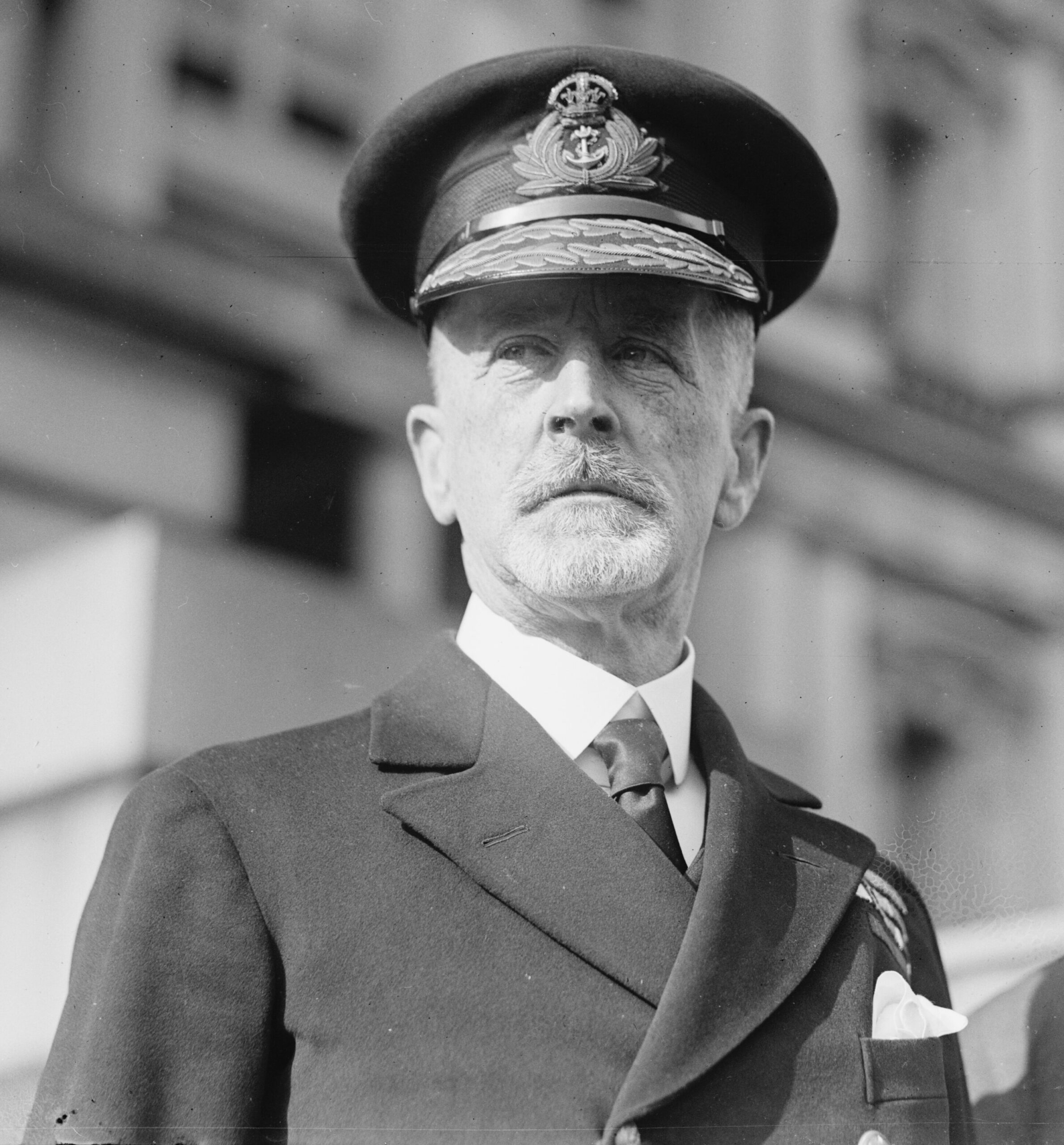
The history of naval combat is often told through the lens of massive steel leviathans and the thunder of heavy batteries. We speak of the HMS Dreadnought as a pivot point in human engineering, but we rarely discuss the man who stood on a blood-slicked bridge to prove why that ship had to exist. That man was Admiral Sir William Christopher Pakenham, a Royal Navy officer whose stoicism wasn’t just a personality trait—it was a scientific instrument that changed the course of the 20th century.
The Great Naval Silence: 1805 to 1904
By the turn of the century, the British Royal Navy was a force of prestige that had not fought a major fleet action since Trafalgar in 1805. In the intervening hundred years, wood and sail had been replaced by Krupp cemented armor and 12-inch breech-loading guns. However, the Admiralty in London was operating on theory. No one knew for certain how steel battleships would behave when the range opened up to 12,000 meters.
When the Russo-Japanese War erupted in February 1904, the Anglo-Japanese Alliance provided a golden ticket. The British sent Pakenham as a Naval Attaché, embedded with the First Fleet of Admiral Tōgō Heihachirō. His orders were simple but grueling: observe, record, and report.
Pakenham took these orders with a literalism that bordered on the obsessive. He boarded the Japanese battleship Asahi, a 15,200-ton behemoth, and stayed there. For fourteen continuous months, he refused to set foot on dry land. His “fear” wasn’t of the Russian mines or the freezing spray of the Yellow Sea; it was the professional dread that the Japanese fleet might sail for a decisive engagement while he was ashore stretching his legs.
Tsushima: The Laboratory of Fire
On May 27, 1905, the theoretical era of naval warfare ended in the Tsushima Strait. The Russian Second Pacific Squadron, having sailed 18,000 miles, met the Imperial Japanese Navy in a clash that would annihilate an empire’s maritime power.
Pakenham chose a position on the exposed after bridge of the Asahi. It was a tactical choice; he didn’t want to crowd the Japanese commander in the conning tower. From this precarious perch, he watched the Asahi fire over 140 rounds of 12-inch shells. He watched the “Yellow Magic”—the Shimose powder—tear through Russian hulls.
The data Pakenham gathered was granular and revolutionary:
- Engagement Ranges: He noted that secondary batteries (6-inch guns) were virtually useless at the 12,000-meter range where the battle was decided.
- Fuse Efficiency: He documented how delayed-action fuses allowed shells to penetrate armor before detonating, maximizing internal damage.
- Ballistics and Accuracy: The Asahi took six direct hits. One shell detonated near Pakenham, killing the sailors around him and soaking his white dress uniform in blood.
In an act that defined his character, Pakenham didn’t flinch. He walked below, changed into a fresh, crisp white uniform, and returned to his notes. This wasn’t bravado; it was a refusal to let the chaos of war interfere with his duty as a witness.
From the Asahi to the HMS Dreadnought
Pakenham’s reports acted as a catalyst for the First Sea Lord, Sir John “Jackie” Fisher. The data from Tsushima provided the empirical evidence needed to kill the “mixed-battery” battleship. If secondary guns were useless at long range, why carry them?
The result was the HMS Dreadnought (1906).
- Armament: It featured ten 12-inch guns, making it twice as powerful as any previous ship.
- Speed: It was the first major warship powered by Parsons steam turbines, hitting 21 knots.
- Impact: It rendered the world’s navies obsolete overnight. The “Dreadnought Race” began, fueled by the notes Pakenham took while covered in the blood of his allies.
The Crucible of Jutland
By 1916, Pakenham was a Rear Admiral commanding the 2nd Battlecruiser Squadron. His journey to the Battle of Jutland was marred by misfortune. Three weeks before the engagement, his flagship, HMAS Australia, collided with the HMS New Zealand in a thick fog.
The Australia—a symbol of Commonwealth naval power—was sidelined. Pakenham transferred his flag to the New Zealand, entering the largest naval battle of World War I with a depleted force. On May 31, 1916, he watched from the bridge as the HMS Indefatigable was struck by a salvo from the German SMS Von der Tann.
The statistics of that moment remain haunting: of the 1,018 men aboard the Indefatigable, only three survived. Yet, as he had done on the Asahi, Pakenham remained a pillar of composure. He adjusted his formation and continued the fight.
The Friction with Beatty: A Study in Command
Pakenham’s superior, Admiral Sir David Beatty, was a man of “flair.” Beatty valued aggression and impulse. He famously remarked that Pakenham was the only officer who “deeply disappointed” him, citing a lack of tactical imagination.
However, modern military analysis offers a more nuanced view. While Beatty sought the “Nelson Touch,” Pakenham embodied Precision and Sustainability. He was a product of the machine age—calculating, steady, and unmovable. Beatty demanded instinct; Pakenham provided a disciplined execution that ensured the 2nd Battlecruiser Squadron remained a functional unit despite catastrophic losses.
Legacy of the Silent Admiral
William Pakenham retired in 1926. He never sought the limelight, never wrote a sensational memoir, and spent his final years in the quiet halls of the Turf Club in Piccadilly. When he died in 1933, he left behind a legacy that was built into the very steel of the Royal Navy.
He was the “Warrior” he described in his final dispatch from the Asahi. He understood that while 12-inch guns and Krupp armor defined the parameters of the fight, the ultimate variable was the man who refused to leave the bridge.
| Key Metric | Pre-Dreadnought (Asahi) | Dreadnought Class |
| Main Battery | 4 × 12-inch guns | 10 × 12-inch guns |
| Effective Range | ~6,000 – 8,000m | 12,000m+ |
| Top Speed | 18 Knots | 21 Knots |
| Propulsion | Reciprocating Engines | Steam Turbines |
Pakenham’s life serves as a reminder that history isn’t just made by the people who lead the charge, but by the people who have the courage to watch, record, and remain unchanged when the world is exploding around them. He was a Royal Navy officer—not just by rank, but by a fundamental, unbreakable identity.
In an era of “big data” and “algorithmic warfare,” Pakenham’s 14-month vigil on the Asahi stands as the ultimate example of human-centric intelligence. He proved that the most important sensor on a 15,000-ton battleship is the human eye that refuses to look away.