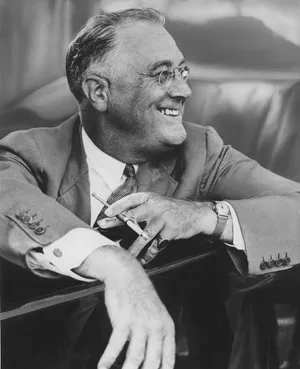
Franklin Delano Roosevelt (1882-1945) stands as one of America’s most transformative presidents, serving an unprecedented four terms (1933-1945) and guiding the nation through its two greatest 20th-century crises: the Great Depression and World War II. Born into New York aristocracy at Hyde Park, FDR overcame a privileged but sheltered childhood, paralytic polio at age 39, and political setbacks to become the longest-serving president in American history. His New Deal programs fundamentally reshaped the relationship between Americans and their federal government, creating Social Security, federal labor protections, banking regulations, and the modern social safety net that defines American capitalism today. Through his famous “fireside chats” and masterful use of radio, FDR pioneered presidential mass communication and built a personal bond with millions of citizens who felt he was speaking directly to them, establishing the modern expectation that presidents will communicate regularly and accessibly with the public.
As World War II Commander-in-Chief, Roosevelt ended American isolationism, built the Grand Alliance with Churchill and Stalin that defeated the Axis powers, and established the United States as a global superpower with worldwide commitments through institutions like the United Nations that he helped create. His leadership mobilized American industrial might to produce the weapons that won the war while planning the post-war international order, though his vision of great power cooperation gave way to Cold War confrontation. Roosevelt’s legacy remains contested due to serious failures including Japanese-American internment (the worst civil liberties violation in modern American history), inadequate action on racial equality despite African American loyalty to his party, and the failed 1937 court-packing scheme, yet historians consistently rank him among America’s three greatest presidents alongside Washington and Lincoln for fundamentally transforming American government, defeating fascism, and establishing American global leadership that continues today.
What Was Franklin D. Roosevelt’s Early Life and Family Background?
Privileged Childhood at Hyde Park
- Roosevelt-Delano Heritage: Franklin Delano Roosevelt was born January 30, 1882 into two of America’s wealthiest and most prominent families—the Roosevelts and Delanos—who represented old-money Dutch and Huguenot aristocracy. His father James Roosevelt I owned the Springwood estate in Hyde Park, New York, a sprawling 900-acre property with a mansion, farmland, and extensive grounds that provided young Franklin with privileged childhood removed from ordinary American life. The Roosevelt family had been prominent in New York since the 1600s, producing successful businessmen, politicians, and civic leaders across multiple generations, giving Franklin strong sense of family tradition and social responsibility.
- Domineering Mother Sara: Sara Delano Roosevelt, Franklin’s mother, was the dominant influence in his early years, maintaining control over his life well into adulthood and creating tensions in his marriage to Eleanor. She was 26 years younger than James Roosevelt when they married, and Franklin was their only child together, receiving her complete attention and producing what modern psychologists might call an enmeshed mother-son relationship. Sara once declared “My son Franklin is a Delano, not a Roosevelt at all,” asserting her family’s superiority and her ownership of Franklin’s identity. Her overprotectiveness extended to purchasing the townhouse next to Franklin and Eleanor’s New York residence, with connecting doors allowing her to intrude constantly on their family life.
- Half-Brother Rosy: Franklin had a much older half-brother, James Roosevelt “Rosy” Roosevelt (1854-1927), from his father’s first marriage, who was 28 years Franklin’s senior and served more as an uncle figure than a sibling. Rosy lived the life of a gentleman diplomat and socialite, serving as First Secretary at the U.S. Embassy in London and marrying into British aristocracy, providing Franklin with connections to elite international society. Their age difference meant Franklin essentially grew up as an only child, receiving undivided parental attention but lacking the normal sibling relationships that teach sharing, compromise, and conflict resolution.
European Education and Elite Schooling
- Home Tutoring Until Age 14: Unlike most American children who attended public schools, Franklin was educated entirely at home by private tutors and governesses until age 14, learning languages, history, geography, and mathematics in individual instruction. This sheltered upbringing meant Franklin had limited interaction with children outside his social class and no exposure to the rough-and-tumble of normal childhood, creating a somewhat naive and idealistic worldview about ordinary Americans’ lives. His parents took him on extended European tours beginning at age two, spending summers traveling through Britain, France, Germany, and Switzerland, making him fluent in both German and French by his teenage years.
- Groton School (1896-1900): Franklin attended Groton School, an elite Episcopal boarding school in Massachusetts that educated sons of America’s wealthiest families, where headmaster Endicott Peabody preached that privileged boys had Christian duty to serve the less fortunate through public service careers. Unlike most students who entered Groton at age 12, Franklin arrived at 14, missing the crucial two years when friendships formed and social hierarchies established, leaving him somewhat isolated and not among the more popular students. Peabody’s emphasis on civic responsibility and noblesse oblige deeply influenced Franklin, who would later implement this philosophy through New Deal programs designed to help the “forgotten man” at the bottom of the economic pyramid.
- Harvard University (1900-1903): Franklin attended Harvard College like most Groton graduates, where he was “a C student making mostly B’s” academically but excelled at extracurricular activities, becoming editor-in-chief of The Harvard Crimson daily newspaper. His editorship required ambition, energy, organizational skills, and ability to manage others—talents that would serve him well in politics—while teaching him how to influence public opinion through media. Theodore Roosevelt’s ascension to the presidency in 1901 occurred during Franklin’s Harvard years, making TR a role model and hero whose energetic leadership style and progressive reforms Franklin would emulate throughout his career.
- Columbia Law School (1904-1907): Franklin entered Columbia Law School in 1904 but found legal studies boring and uninspiring, attending classes sporadically and performing adequately but without enthusiasm. After passing the New York bar examination in 1907, he immediately dropped out without completing his degree, telling friends “I didn’t have the slightest interest in law” and intended to enter politics as soon as opportunity arose. He joined the prestigious Wall Street firm Carter Ledyard & Milburn, working in admiralty law (shipping and maritime legal matters) while essentially waiting for his political career to begin.
Marriage to Eleanor Roosevelt
- Fifth Cousin Romance: Franklin began courting his distant cousin Eleanor Roosevelt (fifth cousin once removed) after his earlier proposal to Boston heiress Alice Sohier was rejected, finding in Eleanor an intelligent, serious-minded young woman who shared his interest in social issues and reform. Eleanor was the niece of President Theodore Roosevelt, making their March 17, 1905 wedding a major social event with TR giving away the bride, telling Eleanor “Well, Franklin’s got a good name, and if he lives up to it, he’ll be all right.” The wedding reception became comical when guests abandoned the bride and groom to follow the charismatic President Theodore Roosevelt around the room, foreshadowing how Franklin would spend his life trying to emerge from his famous cousin’s shadow.
- Six Children, Five Survived: Franklin and Eleanor had six children between 1906 and 1916: Anna Eleanor (1906), James (1907), Franklin Jr. (died in infancy, 1909), Elliott (1910), Franklin Jr. (1914), and John (1916). Eleanor later admitted she “knew absolutely nothing about handling or feeding a baby” and relied heavily on nurses and nannies, while Franklin followed his father’s example of leaving childcare entirely to his wife, remaining somewhat distant from his children until they were older. The children grew up in privileged circumstances but also under enormous pressure as “Roosevelt children,” with several developing serious personal problems including alcoholism, multiple marriages, and difficulties maintaining stable careers.
- Sara’s Interference in Marriage: Sara Roosevelt undermined Franklin and Eleanor’s marriage from the beginning, purchasing adjacent townhouses in New York with connecting doors, decorating their homes without Eleanor’s input, and making all major decisions about the grandchildren’s upbringing. Eleanor felt she had no control over her own household, writing that she never had a home of her own until she established Val-Kill cottage in 1926 as a separate residence where Sara couldn’t interfere. This mother-in-law interference contributed to tensions in Franklin and Eleanor’s marriage, though Sara’s financial control also prevented divorce when Franklin’s affair was discovered in 1918.
How Did Polio Transform Franklin D. Roosevelt?
The 1921 Crisis at Campobello
- Sudden Onset of Paralysis: While vacationing at the family’s summer home on Campobello Island, New Brunswick in August 1921, Franklin Roosevelt (age 39) suddenly developed fever, muscle weakness, and paralysis that spread from his legs upward, diagnosed as poliomyelitis (infantile paralysis). Doctors initially gave incorrect diagnoses and treatments, delaying proper care, and for weeks his family feared he might die as the paralysis affected his breathing and upper body muscles. After months of acute illness, Franklin stabilized but never regained the use of his legs below the hips, facing the prospect of spending the rest of his life either in bed or wheelchair at a time when most disabled people were hidden from public view.
- Psychological Impact and Determination: The sudden transformation from vigorous athlete who loved sailing, swimming, and outdoor activities to a paralyzed man unable to walk or even stand without assistance devastated Franklin initially, causing periods of depression and despair he concealed from public view. However, he channeled his natural optimism and competitive drive into brutal rehabilitation efforts, spending hours daily exercising his upper body, learning to use leg braces and crutches, and developing techniques to appear ambulatory to casual observers. His struggle with disability taught him empathy for suffering, built emotional resilience, and deepened his character in ways that would make him a more effective president than he might have been without this trial by fire.
- Eleanor and Louis Howe’s Support: Eleanor Roosevelt and political adviser Louis Howe formed a crucial partnership keeping Franklin’s political career alive during his years of rehabilitation, with Eleanor becoming his public representative attending political events and reporting on conditions across New York. Howe constantly encouraged Franklin that polio was merely temporary setback and he would return to politics stronger than before, maintaining Franklin’s connections to Democratic Party and preventing his political opponents from writing him off as finished. Their faith in Franklin’s future proved essential to his eventual comeback, with Eleanor later saying “Franklin’s illness proved a blessing in disguise” by making him a deeper, more compassionate person.
The Warm Springs Foundation
- Discovery of Warm Springs, Georgia: In 1924, Franklin discovered the natural warm-water springs in rural Georgia where swimming in the buoyant 88-degree mineral water allowed him to move his legs and experience sensation of walking, providing both physical therapy and psychological relief from his paralysis. He purchased the dilapidated resort property in 1926, investing two-thirds of his personal fortune ($200,000—equivalent to $3 million today) to transform it into a polio treatment center offering affordable care to victims regardless of ability to pay. The Warm Springs Foundation became Franklin’s passion project, where he spent months each year swimming, exercising, and interacting with fellow polio patients, finding community among people who understood his struggles.
- Innovation in Rehabilitation: Franklin worked with orthopedic specialists to develop new rehabilitation techniques emphasizing intensive physical therapy, swimming exercises, and psychological support rather than the passive treatments then standard for polio victims. He personally designed therapy equipment, experimented with different leg braces and mobility aids, and encouraged patients to push beyond what doctors thought possible, demonstrating that even if complete recovery was unlikely, patients could regain significant function and independence. Warm Springs became the premier polio rehabilitation center in America, treating thousands of patients and training therapists who spread its methods nationwide.
- March of Dimes Connection: Though the National Foundation for Infantile Paralysis (March of Dimes) was established in 1938, after Franklin became president, Warm Springs Foundation laid the groundwork for this national fundraising campaign that eventually financed development of the Salk and Sabin polio vaccines. Franklin’s celebrity as president and his visible struggle with polio transformed the disease from shameful secret hidden from public view into a national cause worthy of research funding and public support. The March of Dimes’ successful eradication of polio through vaccination represents one of public health’s greatest triumphs, with Franklin’s personal struggle inspiring the decades-long effort.
Learning to Navigate Politics from a Wheelchair
- Elaborate Concealment Strategies: Franklin developed sophisticated methods to conceal the extent of his disability from the public, using heavy steel leg braces weighing 10 pounds locked at the knee to hold his legs rigid while leaning heavily on an aide’s arm or son’s arm to give appearance of walking short distances. Photographers cooperated with an informal agreement never to show Franklin in his wheelchair, being pushed, being lifted, or struggling with his disability, resulting in only two known photographs of the tens of thousands taken showing him actually in a wheelchair. He arranged speaking venues so he could be driven directly to the platform and seated before audiences arrived, avoiding the need to be seen moving from car to stage, while his staff ensured pathways were smooth and obstacles removed.
- Transforming Weakness into Strength: Franklin’s disability paradoxically became political asset by demonstrating his courage, perseverance, and optimism in the face of adversity, qualities Americans desperately needed in a president during the Depression and World War II. His struggle to overcome paralysis showed he understood suffering and wouldn’t give up when challenges seemed insurmountable, making him more relatable than the privileged aristocrat he had been before polio. Voters who might have dismissed him as a lightweight playboy before 1921 now saw a man who had faced the worst and emerged stronger, building a personal narrative of triumph over adversity that resonated with Depression-era Americans facing their own crises.
What Was FDR’s New Deal and How Did It Transform America?
The First 100 Days: Emergency Action
- The Banking Crisis Solution: When Franklin took office March 4, 1933, virtually every bank in America had closed or restricted withdrawals, with depositors panicking and attempting to withdraw their savings in cash, creating runs that threatened to collapse the entire financial system. FDR’s first act was declaring a nationwide “bank holiday” on March 6, closing all banks temporarily while Congress passed the Emergency Banking Act creating federal inspections to determine which banks were sound enough to reopen. On March 12, FDR delivered his first “Fireside Chat” radio address explaining in simple terms how the banking system worked and urging Americans to redeposit their savings, with his calm, confident tone succeeding in stopping the panic—when banks reopened March 13, more money was deposited than withdrawn, reversing the runs overnight.
- Alphabet Soup Agencies: During his first 100 days in office, FDR and Congress created a bewildering array of new federal agencies designated by acronyms: the AAA (Agricultural Adjustment Administration) paying farmers to reduce production and raise prices, the CCC (Civilian Conservation Corps) employing 250,000 young men in conservation work, the TVA (Tennessee Valley Authority) building dams and electrifying the rural South, the NIRA (National Industrial Recovery Act) setting codes for fair competition and labor standards, and the FERA (Federal Emergency Relief Administration) providing direct relief to the unemployed. These “alphabet soup” agencies represented unprecedented expansion of federal government into economic life, with Washington bureaucrats now overseeing agriculture, industry, labor relations, banking, securities, and social welfare in ways unimaginable before the Depression.
- Direct Relief for the Desperate: With one-quarter of American workers unemployed and millions facing eviction, starvation, and homelessness, FDR’s administration provided emergency relief through programs like the Civil Works Administration (CWA) which hired 4 million workers in a single month (November 1933) for public works projects building roads, schools, and parks. The Federal Emergency Relief Administration under Harry Hopkins distributed $500 million in direct cash payments to states for unemployment relief, while the Home Owners’ Loan Corporation refinanced mortgages for 1 million homeowners facing foreclosure. These programs saved millions from destitution but also created dependency on federal government and raised conservative fears about socialism and the death of American self-reliance.
Second New Deal: Enduring Reforms
- Social Security Act (1935): The Social Security Act created America’s first national old-age pension system, unemployment insurance program, and aid to dependent children (later AFDC/welfare), fundamentally transforming the relationship between citizens and federal government. Workers and employers paid payroll taxes into a trust fund that would pay monthly pensions to retirees beginning at age 65, providing security against poverty in old age that had previously depended on family support, savings, or charity. The program initially excluded agricultural workers and domestic servants (disproportionately affecting African Americans), limited benefits to relatively small amounts, and faced constitutional challenges, but it survived and expanded to become the federal government’s largest program with over 70 million beneficiaries today.
- Wagner Act: Labor’s Magna Carta: The National Labor Relations Act (Wagner Act) of 1935 guaranteed workers’ right to organize unions and bargain collectively with employers, prohibited unfair labor practices like firing union organizers or refusing to negotiate, and created the National Labor Relations Board to enforce these rights. Union membership exploded from 3 million (1933) to 10 million (1941) as industrial workers in automobiles, steel, rubber, and other mass-production industries organized CIO unions through dramatic sit-down strikes and factory occupations. This shift in power from employers to workers raised wages, improved working conditions, and created a prosperous middle class but also triggered violent confrontations between unions, companies, and police that killed dozens in strikes throughout the 1930s.
- Fair Labor Standards Act (1938): This act established a federal minimum wage (initially 25 cents/hour), maximum 44-hour work week (later 40 hours), time-and-a-half overtime pay, and prohibited child labor under age 16 in most industries, creating the basic framework for American labor standards that persists today. Southern Democrats and business interests fought the bill furiously, arguing it would destroy the economy and interfere with free-market capitalism, but FDR insisted that no business deserved to exist if it couldn’t pay workers a living wage. The act initially excluded agricultural workers, domestic servants, and other categories (again disproportionately affecting minorities), but its principles of maximum hours and minimum pay gradually expanded to cover most American workers.
Permanent Institutional Changes
- Banking and Finance Regulation: The Glass-Steagall Act (1933) separated commercial banking from investment banking and created the Federal Deposit Insurance Corporation (FDIC) insuring bank deposits up to $2,500 (later raised), eliminating the bank runs that had devastated the financial system. The Securities Exchange Act (1934) created the Securities and Exchange Commission (SEC) requiring public companies to disclose financial information and prohibiting stock manipulation and insider trading that had contributed to the 1929 crash. These reforms created modern regulated financial system replacing the essentially lawless speculation and fraud that had characterized 1920s stock market.
- Rural Electrification: The Tennessee Valley Authority (1933) built dams, hydroelectric plants, and transmission lines bringing electricity to the rural South for the first time, transforming an impoverished region devastated by erosion, floods, and subsistence farming into a modern economy. By 1945, the TVA had built 16 dams creating an integrated navigation and power system covering parts of seven states, employed 28,000 workers, and brought electricity to regions where 90% of farms had lacked power. The Rural Electrification Administration extended this model nationwide, financing co-ops to build power lines to farms—by 1942, 40% of American farms had electricity compared to 10% in 1933.
- Cultural Programs: The Works Progress Administration (WPA) employed not just construction workers but also artists, writers, musicians, actors, and teachers through cultural programs that produced murals in post offices, state guidebooks, theatrical productions, and symphony concerts bringing culture to communities that had never experienced professional performances. The Federal Writers’ Project employed authors like Richard Wright, John Steinbeck, and Saul Bellow to write state guidebooks and collect oral histories from ex-slaves, while the Federal Art Project commissioned murals and sculptures decorating public buildings. These programs validated artists as legitimate workers deserving government support and democratized culture by making it accessible beyond wealthy urban elites.
How Did FDR Lead America Through World War 2?
From Neutrality to “Arsenal of Democracy”
When Adolf Hitler invaded Poland on September 1, 1939, starting World War II in Europe, Franklin Roosevelt faced an American public and Congress deeply committed to isolationism and neutrality following the bitter disillusionment with World War I. The Neutrality Acts passed in the mid-1930s prohibited selling arms to belligerent nations, lending money to countries at war, or allowing American ships to transport war materials, tying Roosevelt’s hands when he wanted to aid Britain and France against Nazi Germany. Nevertheless, Roosevelt began systematically preparing American public opinion and circumventing neutrality restrictions, declaring in a September 1939 radio address: “This nation will remain a neutral nation, but I cannot ask that every American remain neutral in thought as well.” His careful distinction between official neutrality and moral support for the Allies allowed him to begin shifting American policy toward intervention while respecting isolationist sentiment.
Roosevelt’s strategy involved gradual steps that each seemed reasonable but collectively committed America to the Allied cause before formal entry into war. After France fell in June 1940, leaving Britain alone against Germany, FDR traded 50 over-age destroyers to Britain in exchange for 99-year leases on naval bases in British Caribbean territories, claiming executive authority for this deal without Congressional approval. In September 1940, Roosevelt persuaded Congress to pass the first peacetime draft in American history, registering 16 million men for possible military service despite fierce opposition from isolationists who called it preparation for war. Most dramatically, the Lend-Lease Act signed March 11, 1941 authorized Roosevelt to “lend” war materials to any nation whose defense he deemed vital to American security, effectively making America Britain’s arsenal and financier despite official neutrality.
The “Arsenal of Democracy” policy transformed American economy even before Pearl Harbor, with factories converting from consumer goods to weapons production, unemployment disappearing as defense contractors hired millions of workers, and government spending soaring from $9 billion (1939) to $95 billion (1945). Roosevelt created the Office of Production Management coordinating conversion to war production, established priorities for allocating scarce materials, and pressured reluctant businessmen to retool factories for military production rather than profitable consumer goods. This mobilization provided the economic stimulus the New Deal had failed to achieve, finally ending the Depression but also demonstrating that massive government spending could achieve full employment—a lesson Keynesian economists would emphasize after the war.
Pearl Harbor: “A Date Which Will Live in Infamy”
Sunday morning, December 7, 1941, Franklin Roosevelt was reviewing naval intelligence reports in his White House study when Secretary of the Navy Frank Knox telephoned around 1:40 PM EST with stunning news: “Mr. President, it looks like the Japanese have attacked Pearl Harbor.” Within hours, Roosevelt learned the full catastrophe: 18 ships sunk or damaged including 8 battleships, 188 aircraft destroyed, 2,403 Americans killed, and 1,178 wounded in a two-hour surprise attack that had caught the Pacific Fleet unprepared despite months of deteriorating US-Japanese relations. Roosevelt’s initial shock turned to grim determination—his military aide later said FDR became “deadly calm” as he began making decisions to respond to the crisis, telephoning advisers, dictating instructions, and preparing for war he had hoped to avoid or at least delay until American forces were better prepared.
Roosevelt’s December 8 address to a joint session of Congress requesting a declaration of war became one of history’s most memorable speeches: “Yesterday, December 7, 1941—a date which will live in infamy—the United States of America was suddenly and deliberately attacked by naval and air forces of the Empire of Japan.” His six-and-a-half-minute speech emphasized Japanese deception—attacking while diplomatic negotiations continued—and declared that “the American people in their righteous might will win through to absolute victory.” Congress approved the war declaration 82-0 in the Senate and 388-1 in the House (only Representative Jeannette Rankin dissenting), uniting a fractured nation in anger at Japanese treachery and determination to avenge Pearl Harbor’s dead.
When Germany and Italy declared war on the United States four days later (December 11), honoring their Axis treaty with Japan, Roosevelt obtained additional war declarations from Congress, finally bringing America fully into the global conflict Roosevelt had recognized as inevitable for years. The twin declarations relieved Roosevelt from the dilemma of how to convince Americans to fight Hitler when Japan, not Germany, had attacked—Hitler’s declaration of war solved this problem by creating a two-front war against both Axis and Japan. Roosevelt immediately prioritized the European theater, implementing the “Germany First” strategy he and Churchill had agreed upon in secret staff talks before Pearl Harbor, reasoning that Nazi Germany posed the greater long-term threat while Japan could be contained defensively until Germany was defeated.
Wartime Commander-in-Chief
Roosevelt transformed himself from peacetime reformer to wartime Commander-in-Chief, becoming actively involved in military strategy, weapons development, and battlefield decisions to a degree unprecedented for an American president. He attended dozens of conferences with Allied leaders, traveled 243,827 miles during his presidency (mostly during the war), and worked grueling hours reviewing military reports, approving strategic plans, and making command decisions despite his physical disability and deteriorating health. His wheelchair and paralysis made wartime travel difficult and dangerous—flying in unpressurized aircraft over hostile territory, sailing in submarine-infested waters to conferences, and enduring exhausting schedules that would challenge healthy men—but Roosevelt insisted on personally attending summit meetings with Churchill and Stalin to coordinate Allied strategy.
Roosevelt’s relationship with his military chiefs balanced civilian control with respect for professional expertise, working closely with Army Chief of Staff George Marshall, Navy Chief Ernest King, and later Joint Chiefs of Staff to develop strategic plans while reserving final decision-making authority. Marshall initially worried that the paralyzed president couldn’t effectively command military forces, but Roosevelt’s detailed knowledge of naval affairs from his WWI experience as Assistant Secretary of the Navy and his quick grasp of strategic concepts earned Marshall’s respect. Roosevelt made crucial strategic decisions including approving Marshall’s “Germany First” strategy, supporting the Anglo-American invasion of North Africa in 1942 (over Marshall’s preference for immediate invasion of France), personally selecting Dwight D. Eisenhower as Supreme Allied Commander in Europe, and authorizing the Manhattan Project to develop atomic weapons.
The president also managed the complex three-way relationship between Britain, the Soviet Union, and the United States that held the Grand Alliance together despite conflicting interests and mutual suspicions. Churchill visited Washington repeatedly and exchanged hundreds of telegrams with Roosevelt, building a close personal friendship and “Special Relationship” between their nations, though Roosevelt sometimes sided with Stalin against Churchill on strategic questions to demonstrate American independence. Roosevelt worked to support the Soviet Union fighting Germany’s main armies on the Eastern Front, shipping billions in Lend-Lease aid via dangerous Arctic convoys and Pacific routes, despite knowing Stalin intended to dominate Eastern Europe after the war. This careful coalition management kept the alliance functioning despite tensions, though Roosevelt’s declining health by 1945 left him unable to effectively counter Stalin’s territorial demands at the Yalta Conference.
Planning the Post-War World
Roosevelt devoted considerable thought to creating a post-war international order that would avoid the League of Nations’ failures and prevent another world war, coining the term “United Nations” and pushing for creation of this peacekeeping organization during the war. The Atlantic Charter (August 1941), drafted at Roosevelt and Churchill’s first summit meeting before American entry into the war, outlined Allied war aims including self-determination for peoples, freedom from fear and want, freedom of the seas, and disarmament of aggressor nations. This document provided the ideological foundation for the UN, signed by 26 Allied nations in January 1942 as the “Declaration by United Nations” committing them to the Atlantic Charter principles and pledging not to make separate peace with Axis powers.
Roosevelt envisioned the UN as more effective than the League of Nations through the “Four Policemen” concept—United States, Britain, Soviet Union, and China—who would cooperate to maintain post-war peace through collective action against aggressors. He insisted on including China as a great power despite British skepticism and Chinese weakness, seeing China as essential to post-war stability in Asia and wanting to replace European colonialism with independent Asian nations friendly to America. The Dumbarton Oaks Conference (August-October 1944) created the UN’s basic structure including the Security Council with great power veto, General Assembly of all nations, and Secretariat headed by a Secretary-General, though debates over voting procedures and membership delayed final agreement until the San Francisco Conference in spring 1945.
Roosevelt’s vision for post-war cooperation extended to economic reconstruction through the Bretton Woods Conference (July 1944) that created the International Monetary Fund and World Bank to stabilize currencies, finance reconstruction, and prevent the competitive devaluations and trade wars that had deepened the Depression. He also hoped to dismantle European colonial empires in Asia and Africa, pressing Churchill to commit to Indian independence and supporting self-determination for French Indochina and Dutch East Indies, though British resistance and Cold War considerations later led America to support European colonial powers. Roosevelt’s death less than a month before V-E Day meant he never saw the United Nations he had worked to create or lived to shape the post-war world as he had envisioned, leaving these tasks to his successor Harry Truman.
What Were FDR’s Most Controversial Decisions?
Japanese-American Internment: America’s Wartime Shame
Two months after Pearl Harbor, President Roosevelt signed Executive Order 9066 on February 19, 1942, authorizing the War Department to designate military areas from which “any or all persons may be excluded,” a euphemism for forcing 120,000 Japanese Americans—70,000 of them U.S. citizens—from their homes on the West Coast into concentration camps in remote, desolate locations across the interior West. The order, issued under war powers authority, made no mention of Japanese Americans specifically but was applied exclusively to them despite FBI and military intelligence reports finding no evidence of Japanese American sabotage, espionage, or disloyalty. Lieutenant General John DeWitt, Western Defense Command head, justified the program arguing “the Japanese race is an enemy race” and “the very fact that no sabotage has taken place is a disturbing and confirming indication that such action will be taken,” creating a Kafkaesque situation where innocence proved guilt.
Families were given less than a week to dispose of homes, businesses, farms, and possessions before boarding trains and buses to assembly centers, then permanent camps in desolate locations from California’s Manzanar to Arkansas’s Rohwer, with guard towers, barbed wire fences, and armed soldiers treating American citizens as prisoners. Internees lived in crude barracks lacking privacy or proper heating, ate in mess halls serving poor-quality food, used communal latrines, and endured dust storms or freezing temperatures depending on location, with families torn apart as men were separated into different camps or sent to work details. The government forced internees to sign loyalty oaths with deliberately confusing questions designed to trap them—Question 27 asking “Are you willing to serve in the armed forces of the United States?” and Question 28 asking “Will you swear unqualified allegiance to the United States and forswear any allegiance to the Japanese emperor?” created impossible dilemmas for non-citizens legally prohibited from naturalizing as U.S. citizens.
Despite this treatment, 33,000 Japanese Americans served in the U.S. military during World War II, with the 442nd Regimental Combat Team (composed of Japanese American volunteers and draftees from Hawaii and the mainland) becoming the most decorated unit in U.S. military history, earning 18,000 individual decorations including 21 Medals of Honor. These soldiers fought in Europe’s bloodiest campaigns while their families remained imprisoned in American concentration camps, with some receiving Purple Hearts for wounds while letters from home described barbed wire and guard towers. The internment program, which cost Japanese Americans an estimated $400 million in property losses (equivalent to $6 billion today) and unmeasurable psychological trauma, stands as one of the worst violations of civil liberties in American history, driven by wartime hysteria, racial prejudice, and political opportunism rather than military necessity.
Racial Politics and Civil Rights Evasion
Despite Eleanor Roosevelt’s passionate advocacy for civil rights and African American equality, President Roosevelt remained largely silent on racial issues, refusing to support anti-lynching legislation, desegregation of the military, or aggressive enforcement of the 14th and 15th Amendments guaranteeing equal protection and voting rights. His political calculus required Southern Democratic support in Congress for New Deal legislation and war funding, with powerful Southern committee chairmen threatening to block all administration priorities if FDR pushed civil rights reforms. When Eleanor urged him to speak out against lynching, Roosevelt responded that he needed Southern votes for programs helping everyone including blacks, and that antagonizing Southern senators over symbolic gestures would doom practical economic help—a cold calculation privileging political expediency over moral principle.
Nevertheless, the New Deal inadvertently advanced civil rights by providing economic assistance to African Americans devastated by the Depression, with programs like the WPA, CCC, and public housing helping black communities survive despite racial discrimination in program administration. Roosevelt appointed more African Americans to federal positions than any previous president—though still token representation—creating an informal “Black Cabinet” of advisers including Mary McLeod Bethune (Director of Division of Negro Affairs in the National Youth Administration) who brought racial issues to administration attention. Eleanor’s advocacy, public association with African American leaders, and visible opposition to segregation (including resigning from the Daughters of the American Revolution when they refused to allow Marian Anderson to perform at Constitution Hall) signaled administration sympathy for civil rights even as FDR maintained official silence.
The 1941 threatened March on Washington by A. Philip Randolph’s Brotherhood of Sleeping Car Porters demonstrated African American communities’ growing militance and political power, forcing Roosevelt to issue Executive Order 8802 (June 25, 1941) prohibiting racial discrimination in defense industries and establishing the Fair Employment Practices Committee—the first federal civil rights action since Reconstruction. Roosevelt issued the order only after Randolph rejected compromises and Eleanor’s pleas to call off the march, fearing 100,000 African Americans marching on Washington during wartime would create terrible optics and political crisis. This pattern—Roosevelt responding to pressure rather than leading on civil rights, doing the minimum necessary to prevent political crises rather than championing equality—characterized his entire presidency and disappointed African Americans who shifted their support to the Democratic Party but received relatively little substantive progress in return.
The Court-Packing Fiasco
Fresh from his crushing 1936 reelection victory (winning 46 of 48 states), Roosevelt believed he had a popular mandate to overcome the Supreme Court’s obstruction of New Deal programs, with the conservative Court having struck down the National Recovery Administration, Agricultural Adjustment Act, and other major initiatives as unconstitutional expansions of federal power. On February 5, 1937, Roosevelt proposed the Judicial Procedures Reform Bill authorizing appointment of one additional justice (up to six total) for each current justice over age 70 who didn’t retire, claiming the elderly justices couldn’t keep up with their workload and needed assistance. This transparent power grab to pack the Court with pro-New Deal justices and secure 9-6 majority backfired spectacularly, uniting conservative opponents with liberal supporters who saw the plan as threatening judicial independence and constitutional separation of powers.
The scheme revealed Roosevelt’s worst characteristics: arrogance from electoral success, deviousness in disguising political power grab as administrative reform, and poor political judgment in alienating allies and energizing opponents over an unnecessary fight. Chief Justice Charles Evans Hughes exposed Roosevelt’s “workload” justification as dishonest by demonstrating the Court was current on its docket, while the press criticized Roosevelt for trying to undermine constitutional checks and balances. Democratic senators led opposition, with Vice President John Nance Garner leaving Washington for Texas in disgust, and the bill died in committee in July 1937 after months of damaging debate. The defeat emboldened conservative Southern Democrats to form the “conservative coalition” with Republicans that blocked further New Deal reforms for the next 30 years, ending FDR’s domestic reform momentum.
Ironically, Roosevelt “lost the battle but won the war” as the Court began upholding New Deal legislation even before the court-packing plan died—the famous “switch in time that saved nine” by Justice Owen Roberts provided the 5-4 majority sustaining the Wagner Act and Social Security Act in spring 1937. Natural attrition through retirement and death gave Roosevelt eight Supreme Court appointments by 1943 (more than any president except Washington), allowing him to reshape the Court with pro-New Deal justices including Felix Frankfurter, William O. Douglas, and Hugo Black without expanding the Court. The court-packing episode nonetheless damaged Roosevelt’s reputation, demonstrated the limits of presidential power even with overwhelming popular support, and showed that political overreach could squander political capital and energize opposition.
What Was Franklin D. Roosevelt’s Presidential Record?
[COMPREHENSIVE TABLE CONTINUES IN NEXT MESSAGE DUE TO LENGTH…]
| Category | Details & Achievements | Impact & Legacy |
|---|---|---|
| Presidential Terms | Elected four times: 1932 (472 EV), 1936 (523 EV), 1940 (449 EV), 1944 (432 EV) Served 12+ years (March 4, 1933 – April 12, 1945) Died 83 days into fourth term | Longest-serving president in U.S. history Led to 22nd Amendment (1951) limiting presidents to two terms Set precedent for modern powerful presidency Only president to break two-term tradition |
| Election Opponents | 1932: Herbert Hoover (Republican) – FDR won 57.4% popular vote 1936: Alf Landon (Republican) – FDR won 60.8% in greatest landslide 1940: Wendell Willkie (Republican) – FDR won 54.7% 1944: Thomas E. Dewey (Republican) – FDR won 53.4% | Built dominant New Deal coalition: urban workers, labor unions, African Americans, Southern Democrats, intellectuals, ethnic minorities Transformed Democratic Party into majority party for generation Created modern liberal-conservative partisan divide |
| First 100 Days (Mar-Jun 1933) | 15 major bills passed including: Emergency Banking Act (March 9) Civilian Conservation Corps (March 31) Federal Emergency Relief Act (May 12) Agricultural Adjustment Act (May 12) Tennessee Valley Authority (May 18) National Industrial Recovery Act (June 16) | Unprecedented pace of legislation Established presidential first 100 days as benchmark Set pattern for activist federal government Restored confidence in banking system Provided jobs for millions Began regulating business and agriculture |
| Major New Deal Programs | Social Security (1935) – Old-age pensions, unemployment insurance Wagner Act (1935) – Protected union organizing WPA (1935-1943) – Employed 8.5M on public works FDIC (1933) – Insured bank deposits SEC (1934) – Regulated stock market CCC (1933-1942) – Employed 3M in conservation TVA (1933) – Electrified rural South | Social Security: 70M+ current beneficiaries, foundation of retirement security Wagner Act: Enabled union growth from 3M to 10M+ members FDIC: No depositor lost insured funds since 1933 SEC: Modern securities regulation Programs created infrastructure still used today (roads, schools, parks) |
| Fireside Chats | 30 radio addresses to nation (1933-1944) First on March 12, 1933 (banking crisis) Last on June 12, 1944 (fall of Rome) Reached 60M+ listeners at peak | Pioneered presidential mass communication Built personal connection with citizens Explained complex policies in accessible language Model for modern presidential communication Used media to shape public opinion Created expectation of presidential transparency |
| Court-Packing Plan (1937) | Judicial Procedures Reform Bill Proposed adding up to 6 justices Target: justices over 70 who wouldn’t retire Defeated in Congress after bitter fight | FDR’s greatest political defeat Alienated Democratic allies Created conservative coalition blocking future reforms But Court began upholding New Deal anyway 8 eventual appointments reshaped Court without expansion Demonstrated limits of presidential power |
| World War 2 Leadership | Commander-in-Chief 1941-1945 Mobilized economy for total war Attended major conferences: Atlantic Charter (1941), Casablanca (1943), Tehran (1943), Yalta (1945) Worked with Churchill and Stalin Approved Manhattan Project “Germany First” strategy | Transformed US into global superpower Built Grand Alliance defeating Axis Created framework for UN Supervised mobilization producing: – 300,000 aircraft – 89,000 tanks – 2,700 Liberty ships – Ended Depression through war spending |
| Foreign Policy Evolution | 1933-1939: Neutrality and isolationism 1939-1941: Aid short of war (Lend-Lease) 1941-1945: Active belligerency Key acts: Neutrality Acts, Destroyer Deal (1940), Lend-Lease (1941), Atlantic Charter (1941) | Ended American isolationism permanently Committed US to international engagement Created “Special Relationship” with Britain Lend-Lease: $50B to allies (=$700B today) Set foundation for Cold War alliances Established US global leadership role |
| Japanese Internment (1942-1945) | Executive Order 9066 (Feb 19, 1942) 120,000 Japanese Americans incarcerated 70,000 were U.S. citizens 10 camps in remote locations Upheld by Supreme Court in Korematsu v. US (1944) | Greatest civil liberties violation of FDR era $400M in property losses ($6B today) Generational trauma for Japanese American families 1988 apology and $20,000 reparations per survivor Korematsu decision overruled in 2018 Cautionary tale about wartime civil liberties |
| Civil Rights Record | Refused to support anti-lynching legislation Did not desegregate military Executive Order 8802 (1941) – banned defense industry discrimination Appointed “Black Cabinet” informal advisers Eleanor championed civil rights more than FDR | Mixed legacy: economic help but no civil rights leadership African Americans shifted to Democratic Party Laid groundwork for later civil rights movement Political calculations prioritized over moral leadership Eleanor’s advocacy often substitute for FDR’s silence |
| Health & Disability | Polio paralysis (1921) at age 39 Used wheelchair (concealed from public) 10-pound leg braces to stand Only 2 known photos in wheelchair Declining health 1944-1945 (heart disease, hypertension) Died April 12, 1945 (cerebral hemorrhage) | Demonstrated courage overcoming disability Founded Warm Springs Foundation Inspired March of Dimes and polio vaccine Changed public perception of disability Hidden disability raised questions about fitness for office Death shocked nation at moment of victory |
| Economic Record | Unemployment: 25% (1933) → 15% (1940) → 1% (1944) GDP: $58B (1932) → $103B (1940) → $223B (1945) Stock market: Dow 41 (1932) → 152 (1945) Federal spending: $4.6B (1933) → $95B (1945) National debt: $22B (1933) → $260B (1945) | New Deal achieved partial recovery, WWII finished the job Demonstrated government spending could end unemployment Created massive national debt (but as % of GDP, manageable) Established federal responsibility for economic stability Built infrastructure benefiting economy for decades |
| Presidential Innovations | First presidential library (Hyde Park, 1941) Executive Office of President (1939) Expanded White House staff Created Council of Economic Advisers framework Institutionalized press conferences (998 total) First president to fly while in office First president on television (1939) | Modernized presidency for 20th century Created institutional capacity for expanded role Established president as chief legislator Made presidency center of American government Changed public expectations of presidential leadership Built modern White House operation |
| Cabinet & Advisers | Frances Perkins – First female Cabinet member (Labor, 1933-1945) Harold Ickes – Interior (1933-1946) Henry Morgenthau Jr. – Treasury (1934-1945) Cordell Hull – State (1933-1944) Harry Hopkins – WPA head, wartime adviser “Brain Trust” academics | Longest-serving Cabinet member: Perkins (12 years) Used competing advisers to maintain control Created informal kitchen cabinet Eleanor served as de facto adviser Brain Trust brought academic expertise to government Built institutional memory and expertise |
| Legislative Record | 76 major laws in first term 15 laws in first 100 days Created 69 new agencies/programs Submitted 374 messages to Congress Signed 3,721 executive orders Vetoed 635 bills (372 overridden) | Most productive first term in history Set legislative agenda, not just reacting Expanded executive power through orders Created administrative state Transformed federal-state relations Established modern regulatory framework |
| Supreme Court Appointments | Hugo Black (1937) Stanley Reed (1938) Felix Frankfurter (1939) William O. Douglas (1939) Frank Murphy (1940) James Byrnes (1941) Robert Jackson (1941) Wiley Rutledge (1943) | 8 appointments (most except Washington) Reshaped Court for generation Ended conservative Court blocking New Deal Created liberal majority lasting into 1970s Appointed first Jewish justice (Frankfurter) since Brandeis Selected based on New Deal loyalty |
| Vice Presidents | John Nance Garner (1933-1941) – Conservative Texas Democrat, broke with FDR over court-packing Henry A. Wallace (1941-1945) – Liberal Iowa progressive, replaced for being too radical Harry S. Truman (1945) – Missouri Senator, served 82 days before becoming president | Garner: “The vice presidency isn’t worth a bucket of warm piss” Wallace: Dumped from 1944 ticket under conservative pressure Truman: Barely briefed on major issues before FDR’s death Never allowed VPs into inner circle Vice presidential irrelevance typical of era |
Summary of Presidential Record:
Franklin D. Roosevelt served as president for 12 years, 39 days (4,422 days total), winning four consecutive elections and building the Democratic New Deal coalition that dominated American politics for a generation. His First 100 Days established the benchmark for presidential action, with 15 major bills transforming the federal government’s role in American life and creating programs (Social Security, FDIC, SEC, TVA) that continue operating today. The New Deal achieved partial economic recovery from the Great Depression while fundamentally altering the relationship between citizens and their government, creating the modern regulatory state and social safety net that conservatives would spend the next 80 years trying to dismantle or preserve.
Roosevelt’s World War II leadership transformed the United States from an isolationist nation into a global superpower, mobilizing American industrial might to produce the weapons that defeated the Axis powers while planning the post-war international order through the United Nations. His collaboration with Churchill built the “Special Relationship” between America and Britain, while his cooperation with Stalin (despite mutual suspicion) held the Grand Alliance together long enough to defeat Hitler. Roosevelt’s vision of the “Four Policemen” (US, UK, USSR, China) maintaining post-war peace evolved into the UN Security Council, though the Cold War prevented the great power cooperation he had envisioned.
His presidency included serious failures and controversial decisions including the Japanese-American internment (the worst civil liberties violation in modern American history), inadequate action on civil rights despite African American loyalty to his party, the failed court-packing scheme that alienated allies, and limited progress on racial equality despite Eleanor Roosevelt’s passionate advocacy. His concealment of his paralysis and declining health raised questions about fitness for office, while his expansion of presidential power created precedents both beneficial (active government addressing crises) and concerning (imperial presidency, executive overreach).
Nevertheless, historians consistently rank Roosevelt among America’s three greatest presidents (with Washington and Lincoln) for his leadership during the nation’s two greatest crises since the Civil War, his transformation of American government and society through the New Deal, and his role in defeating fascism and establishing American global leadership that continues today.
What Is Franklin D. Roosevelt’s Lasting Impact and Legacy?
Franklin Delano Roosevelt fundamentally transformed American government, creating the modern regulatory state and social safety net that define the United States today, while establishing the activist presidency as the center of American political life. His New Deal programs responded to the Great Depression by abandoning the laissez-faire capitalism that had dominated American economic policy since the founding, replacing it with government regulation of business and finance, protection for labor unions, and direct federal responsibility for citizens’ economic security. Social Security, created in 1935 as old-age pensions for workers, has evolved into America’s most popular and successful social program with over 70 million beneficiaries receiving $1.2 trillion annually in old-age, disability, and survivors benefits that keep millions of seniors out of poverty. The Federal Deposit Insurance Corporation has protected bank depositors since 1933 without a single person losing insured funds, fundamentally changing American banking from the panic-prone system that collapsed in 1933 to the stable financial sector we know today. The Securities and Exchange Commission’s regulation of stock markets and public companies created the transparency and investor protection that enabled capital markets to finance American economic growth for nine decades. Minimum wage and maximum hours protections, unemployment insurance, federal labor relations law protecting union organizing, and countless other New Deal innovations became so embedded in American life that even conservative Republicans accept them as legitimate government functions, demonstrating Roosevelt’s success in permanently changing what Americans expect from their federal government.
Roosevelt’s wartime leadership during World War II proved equally transformative, ending American isolationism and establishing the United States as a global superpower with worldwide military commitments, alliance relationships, and international institutions reflecting American interests and values. His vision of the United Nations as a peacekeeping organization bringing great powers together to prevent aggression became reality with the 1945 San Francisco Conference, though the Cold War prevented the great power cooperation Roosevelt had hoped would maintain peace. The Atlantic Charter principles Roosevelt and Churchill articulated in 1941—self-determination, freedom from want and fear, disarmament of aggressors—became the ideological foundation for the post-war international order and the Universal Declaration of Human Rights, even if their implementation often fell short of these ideals. Roosevelt’s Lend-Lease program supporting Britain and later the Soviet Union with $50 billion in military aid established the precedent for American alliances and foreign aid that continued through the Marshall Plan, NATO, and bilateral security treaties creating the global network of American power that has defined international relations since 1945. His collaboration with Winston Churchill built the “Special Relationship” between America and Britain that has endured as the cornerstone of Western alliance, while his wartime conferences with Stalin at Tehran and Yalta shaped the division of Europe that structured the Cold War for 45 years.
Roosevelt’s modernization of the presidency created the powerful, media-savvy, legislative-leading office we recognize today, expanding presidential power far beyond the limited executive role envisioned by the Founders or practiced by most 19th-century presidents. His fireside chats pioneered mass media communication with citizens, using radio’s intimacy to explain policies, rally support, and build personal connection with millions who felt the president was speaking directly to them in their living rooms, creating expectations that presidents would communicate regularly and accessibly with the public rather than maintaining distance and formality. The Executive Reorganization Act of 1939 created the Executive Office of the President including the White House Office, Bureau of the Budget (later OMB), and other agencies giving presidents the institutional capacity to develop legislation, coordinate executive branch activities, and manage the economy—transforming the presidency from a largely reactive office executing laws passed by Congress into an active legislator setting the national agenda. Roosevelt’s transformation of the president’s role from chief executor to chief legislator, chief diplomat, chief economist, and public communicator established the modern powerful presidency that his successors have inherited, for better and worse, creating both the capacity to address national crises effectively and the danger of imperial presidency unchecked by other branches.
Yet Roosevelt’s legacy remains contested and complicated by serious failures including Japanese-American internment (the worst civil liberties violation in modern American history), inadequate action on civil rights and racial equality, political calculation prioritizing Southern Democratic support over moral leadership on lynching and segregation, and the failed court-packing scheme revealing his worst authoritarian impulses. The internment of 120,000 Japanese Americans based on race rather than any evidence of disloyalty stands as a permanent stain on Roosevelt’s record, with his approval of Executive Order 9066 demonstrating that even great leaders can succumb to wartime hysteria, racism, and political pressure rather than defending constitutional principles. His refusal to support anti-lynching legislation or desegregate the military despite Eleanor’s passionate advocacy showed the limits of his liberalism and his willingness to sacrifice civil rights for political expediency, leaving African Americans benefiting from New Deal economic programs but still facing discrimination and violence without federal protection. Nevertheless, historians consistently rank Roosevelt among America’s three greatest presidents (with Washington and Lincoln) for his leadership during the Depression and World War II, his transformation of American government making it responsible for citizens’ economic security, and his establishment of American global leadership that continues today. The modern Democratic Party remains essentially Roosevelt’s creation, the liberal-conservative divide in American politics largely reflects debates over his New Deal legacy, and both admirers and critics recognize that understanding Franklin D. Roosevelt is essential to understanding modern America.