
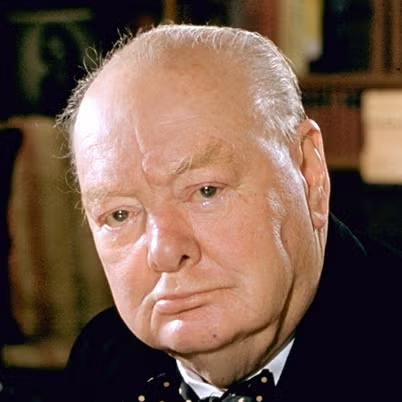
Winston Leonard Spencer-Churchill (1874-1965) stands as one of history’s most consequential leaders, guiding Britain through its darkest hour during World War II with unwavering courage, brilliant oratory, and strategic vision. Born into aristocratic privilege at Blenheim Palace, Churchill overcame academic struggles, childhood neglect, and early career setbacks to forge an extraordinary path through military service in Cuba, India, Sudan, and South Africa, where his dramatic prison escape made him a national hero at age 25. His political career spanned six decades, including controversial positions as First Lord of the Admiralty (where the Gallipoli disaster forced his resignation), Chancellor of the Exchequer (where his gold standard decision damaged Britain’s economy), and a decade of “wilderness years” in the 1930s when his warnings about Nazi Germany were dismissed as alarmist. When Neville Chamberlain’s appeasement policy collapsed and Hitler invaded Poland in 1939, Churchill’s prophetic warnings were finally vindicated, leading to his appointment as Prime Minister on May 10, 1940—the same day Germany launched its devastating western offensive.
Churchill’s wartime leadership proved transformational, with his famous speeches—”We shall fight on the beaches,” “Their finest hour,” and “Never was so much owed by so many to so few”—inspiring British resistance when defeat seemed inevitable and France had fallen. His crucial decision to fight on rather than negotiate with Hitler in May-June 1940, his cultivation of the “Special Relationship” with Franklin D. Roosevelt, his pragmatic alliance with Stalin despite lifelong anti-communism, and his strategic vision coordinating the Grand Alliance that ultimately crushed Nazi Germany established his reputation as Britain’s greatest war leader. However, Churchill’s legacy remains complex and contested: while celebrated as the savior of democracy who stood against totalitarian tyranny, he was also an unrepentant imperialist whose reactionary views on race and empire, responsibility for the 1943 Bengali Famine that killed 3 million, and opposition to decolonization reveal attitudes and policies that modern standards condemn. Today, Churchill is remembered through statues, museums, and continuing cultural presence as both inspirational hero whose courage and eloquence rallied the free world and flawed historical figure whose imperialism and paternalistic racism complicate his heroic narrative, making him perhaps the most debated and reinterpreted British leader of the 20th century.
Who Was Winston Churchill?
Sir Winston Churchill (1874–1965) was an iconic British statesman, orator, and author who served as Prime Minister of the United Kingdom twice (1940–1945 and 1951–1955). He is most celebrated for his resolute leadership during World War II, where his speeches and determination rallied the British people against Nazi Germany
What Made Winston Churchill a Great Leader?
- Unwavering Resolve During Crisis: Churchill possessed extraordinary courage and determination during Britain’s darkest hours in 1940-1941 when the nation stood alone against Nazi Germany after France’s fall. His refusal to consider peace negotiations with Hitler, despite pressure from some cabinet members and the seeming impossibility of victory, demonstrated the iron will that sustained British resistance. Churchill’s famous declaration “We shall never surrender” became the embodiment of British defiance, transforming what appeared to be inevitable defeat into a rallying cry that inspired not just Britain but free peoples worldwide.
- Masterful Oratory and Communication: Churchill’s speeches rank among history’s most powerful and memorable, with phrases like “their finest hour,” “blood, toil, tears and sweat,” and “never was so much owed by so many to so few” entering the English language as permanent expressions. His ability to articulate complex strategic situations in vivid, emotional language that ordinary citizens could understand and embrace made him uniquely effective at mobilizing public support. Churchill understood that in modern total war, maintaining civilian morale was as crucial as military tactics, and his radio addresses reached into millions of homes, providing hope, context, and determination during the Blitz’s nightly terror.
- Strategic Vision and International Coalition Building: Churchill recognized earlier than most that defeating Hitler required an Anglo-American alliance, cultivating his relationship with Franklin D. Roosevelt through hundreds of letters, phone calls, and personal meetings even before America entered the war. His strategic foresight extended to understanding the Soviet Union’s crucial role despite his lifelong anti-communism, pragmatically embracing Stalin as an ally with his quip “If Hitler invaded Hell, I would make at least a favorable reference to the Devil in the House of Commons.” Churchill’s ability to navigate the complex three-way relationship between Britain, America, and the Soviet Union—managing competing interests, egos, and strategic priorities—proved essential to Allied victory.
- Personal Courage and Leading by Example: Unlike many political leaders who remained safely behind lines, Churchill regularly visited bombed areas, military installations, and even frontline positions, sharing danger with his people and troops. During the Blitz, he toured devastated neighborhoods, wept with survivors, and defiantly stood on rooftops watching air raids, demonstrating that Britain’s leader would face the same risks as ordinary citizens. His willingness to fly to besieged Malta, visit troops in North Africa, and cross submarine-infested Atlantic multiple times for conferences with Roosevelt showed a physical bravery that reinforced his rhetorical calls for steadfastness.
When Did Winston Churchill Serve as Prime Minister?
- First Term (May 10, 1940 – July 26, 1945): Churchill became Prime Minister on May 10, 1940, the same day Germany launched its western offensive against France and the Low Countries, inheriting a military catastrophe that would see France’s defeat within six weeks. His appointment came after Neville Chamberlain’s resignation following the failed Norway campaign, with Churchill forming a coalition government that included members of all major parties in recognition of the national emergency. This first premiership spanned Britain’s loneliest and most dangerous period, from Dunkirk evacuation through Battle of Britain, the Blitz, North African campaigns, D-Day invasion, and final victory over Germany in May 1945.
- Wartime Coalition Government: Churchill led a coalition government that suspended normal party politics for the duration of the war, bringing Labour leader Clement Attlee into the War Cabinet as Deputy Prime Minister and including Liberal and Labour ministers in key positions. This unprecedented political unity allowed Churchill to pursue the war effort without partisan opposition, though he still faced criticism from some quarters about strategic decisions. The coalition demonstrated British democracy’s strength—maintaining parliamentary oversight and debate even during existential crisis—while providing Churchill the authority needed to make difficult, unpopular decisions about resource allocation, military strategy, and civilian sacrifice.
- Unexpected Defeat in 1945 Election: Despite leading Britain to victory, Churchill suffered a landslide electoral defeat in July 1945, with voters choosing Labour’s promise of social reform and welfare state over Churchill’s wartime leadership. The election result, announced July 26 while Churchill attended Potsdam Conference, shocked many observers who assumed Britain’s war hero would continue leading peacetime reconstruction. However, voters distinguished between Churchill’s magnificent war leadership and their desire for domestic reform, remembering Conservative Party’s handling of 1930s unemployment and economic hardship while responding to Labour’s promises of nationalized healthcare, better housing, and expanded social security.
- Second Term (October 26, 1951 – April 5, 1955): Churchill returned as Prime Minister in 1951 at age 76, though his second term focused on peacetime governance rather than war leadership and was less successful than his wartime premiership. By this time Churchill’s health was declining—he suffered a serious stroke in 1953 that was concealed from the public—and he struggled to adapt to the post-war world of decolonization, Cold War tensions, and Britain’s reduced global status. He resigned in April 1955 at age 80, finally accepting that age and health prevented him from continuing, handing power to his long-time lieutenant Anthony Eden.
Why Is Churchill Considered Britain’s Greatest Wartime Leader?
- Saved Britain from Defeat and Occupation: In May-June 1940, with France collapsing and Britain facing invasion, Churchill’s refusal to negotiate with Hitler prevented what many considered the “sensible” option of seeking terms. Halifax and other ministers argued that Britain should explore peace possibilities while still holding some bargaining power, but Churchill’s insistence on fighting regardless of odds kept Britain in the war when capitulation appeared rational. This decision, made when Britain stood virtually alone with minimal military forces after Dunkirk evacuation, proved absolutely crucial to eventual Allied victory since Britain provided the base from which D-Day invasion was launched and sustained Soviet Union through Lend-Lease convoys.
- Inspired Unprecedented National Unity and Resilience: Churchill transformed Britain’s darkest hour into the nation’s “finest hour” through rhetoric that gave meaning and nobility to suffering, deprivation, and sacrifice. His speeches during the Blitz helped Londoners endure 57 consecutive nights of bombing, maintaining morale when civilian casualties mounted and entire neighborhoods burned. Churchill’s visible presence in bombed areas, his tears shared with victims, and his defiant gestures (the famous “V for Victory” sign) created personal connection between leader and led that sustained British resolve through years when victory seemed impossible.
- Built the Grand Alliance That Won the War: Churchill’s cultivation of Roosevelt transformed Anglo-American relationship into the “Special Relationship” that became foundation of Allied strategy, with Britain providing experience and intelligence while America contributed industrial might. His management of the difficult alliance with Stalin—praising Soviet resistance while harboring no illusions about communist intentions—maintained coalition unity despite ideological differences and competing territorial ambitions. Churchill’s diplomatic skill navigating between Roosevelt’s idealism, Stalin’s ruthless realism, and Britain’s declining but still significant power proved essential to coordinating the multi-front war that crushed Nazi Germany.
- Provided Strategic Direction and Innovation: Churchill drove innovative military thinking, supporting development of special operations forces, commandos, strategic bombing, and technological innovations like radar and code-breaking at Bletchley Park. His Mediterranean strategy, though controversial among American military leaders who preferred direct assault on France, tied down German forces in North Africa and Italy while providing valuable combat experience before D-Day. Churchill’s interference in military matters sometimes frustrated commanders, but his strategic intuition often proved correct, particularly his insistence on protecting Middle East oil supplies and his concern about Soviet post-war territorial ambitions that Americans initially dismissed.
How Did Churchill’s Early Life Shape His Leadership?
- Aristocratic Background and Sense of Destiny: Born into the aristocratic Spencer-Churchill family at Blenheim Palace, Winston inherited a sense of entitlement and destiny that gave him confidence to pursue leadership despite early setbacks and failures. His father Lord Randolph Churchill’s meteoric political rise and tragic early death (possibly from syphilis) at age 45 haunted Winston, who believed he too would die young and must accomplish greatness quickly. This urgency drove Churchill’s relentless ambition and willingness to take risks that more cautious politicians avoided, shaping the bold, sometimes reckless leader who thrived during crisis but struggled during normal peacetime politics.
- Difficult Childhood and Emotional Resilience: Churchill’s parents largely ignored him, sending him to boarding schools where he endured brutal discipline, bullying, and academic struggles that built emotional resilience and self-reliance. His mother Jennie Jerome, a beautiful American socialite, showed little maternal affection, while his father openly expressed disappointment in Winston’s poor school performance and lack of intellectual sophistication. These early rejections and loneliness created deep emotional wounds but also forged determination to prove himself worthy, driving his need for achievement and recognition that characterized his entire career.
- Military Service Building Physical Courage: Churchill’s adventures as a young cavalry officer and war correspondent in Cuba, India’s North-West Frontier, Sudan, and South Africa’s Boer War gave him firsthand combat experience rare among British politicians. His dramatic escape from Boer prison camp in 1899, walking and riding 300 miles through enemy territory to reach Portuguese East Africa, made him a national hero at age 25 and launched his political career. These experiences taught Churchill that he could face physical danger without losing nerve, confidence that proved invaluable when he later asked millions to endure bombing, invasion threats, and battlefield deaths.
- Self-Education Creating Intellectual Breadth: Despite poor academic record at Harrow and Sandhurst, Churchill became one of history’s most literate statesmen through voracious self-education, reading history, philosophy, and literature throughout his life. His years in India’s garrison life allowed extensive reading of Gibbon, Macaulay, and Plato, developing the historical perspective and prose style that would make his speeches and writings so powerful. Churchill’s ability to place contemporary events in historical context, drawing parallels between Hitler and Napoleon or invoking ancient Athens and Rome, gave his rhetoric depth and resonance that simple propaganda could never achieve.
What Was Winston Churchill’s Early Life and Career?
Where and When Was Winston Churchill Born?
- Birth at Blenheim Palace (November 30, 1874): Winston Leonard Spencer-Churchill was born prematurely at Blenheim Palace, the magnificent baroque country house in Oxfordshire that Queen Anne had granted to John Churchill, 1st Duke of Marlborough, for his military victories. The palace itself symbolized military glory and aristocratic privilege, an appropriate birthplace for someone who would become Britain’s greatest wartime leader. Churchill’s premature birth—his mother Jennie went into labor while attending a ball at Blenheim—was reportedly precipitated by a fall during a hunting expedition, beginning a life that would be marked by dramatic, unexpected events.
- Family Seat of the Dukes of Marlborough: Blenheim Palace represented the Churchill family’s illustrious military heritage, built to commemorate the 1st Duke’s victory over French forces at the Battle of Blenheim in 1704. Though Winston was born into a junior branch of the family and would never inherit the dukedom (which passed through the eldest son’s line), the palace and its history profoundly influenced his sense of identity and destiny. Churchill would later write a four-volume biography of his ancestor the 1st Duke, seeing parallels between Marlborough’s coalition-building against Louis XIV’s France and his own alliance-building against Hitler’s Germany.
- Victorian Britain at Height of Imperial Power: Churchill was born into the Victorian era when Britain ruled the world’s largest empire, controlling one-quarter of the globe’s population and landmass. This context of British supremacy and imperial confidence shaped Churchill’s worldview, instilling belief in British exceptionalism, empire’s civilizing mission, and Anglo-Saxon racial superiority that would mark his politics throughout life. The late Victorian period’s optimism, technological progress, and social hierarchy provided the framework for Churchill’s conservative instincts even as he advocated progressive social reforms early in his career.
- American Maternal Heritage: Through his mother Jennie Jerome, daughter of American financier Leonard Jerome, Churchill had significant American connections that would prove crucial to his later Anglo-American alliance-building. Jennie was one of many wealthy American women who married into British aristocracy during the Victorian period, bringing dollars to support cash-poor noble families. This dual heritage gave Churchill insight into American thinking and genuine affection for the United States that transcended diplomatic calculation, helping him forge the personal relationship with Franklin D. Roosevelt that became cornerstone of Allied grand strategy.
What Was Churchill’s Family Background?
- Father: Lord Randolph Churchill: Winston’s father was a brilliant but erratic Conservative politician who rose to Chancellor of the Exchequer by age 37 before spectacularly resigning in 1886 over a budget dispute, ending his promising career. Lord Randolph’s mercurial temperament, tactical brilliance, and ultimate failure profoundly influenced Winston, who both admired his father’s gifts and feared inheriting his instability and early death. Randolph died in 1895 at age 45 from progressive paralysis (likely tertiary syphilis), having declined into mental and physical deterioration that Winston witnessed during his late teenage years, creating the conviction that he too must achieve greatness quickly before similar fate befell him.
- Mother: Jennie Jerome Churchill: Lady Randolph Churchill was a celebrated beauty and society hostess who provided little emotional warmth to Winston but used her social connections to advance his career. Jennie had numerous affairs throughout her marriage and after Lord Randolph’s death, living a glamorous life that left little room for maternal duties. Despite their emotional distance, Jennie proved useful to Winston’s ambitions, using her relationships with influential men to secure his military postings, war correspondent positions, and early political opportunities. Churchill later acknowledged his mother’s help while lamenting her lack of affection, writing “She shone for me like the Evening Star. I loved her dearly—but at a distance.”
- Aristocratic but Financially Precarious: Despite their aristocratic status and connections to the Duke of Marlborough, the Churchills lived beyond their means in expensive London townhouses while lacking sufficient income. Lord Randolph’s modest parliamentary salary and Jennie’s American dowry proved inadequate for their lavish lifestyle, creating financial pressures that Churchill would experience throughout his own life. This combination of aristocratic entitlement with financial insecurity shaped Churchill’s attitudes toward money—he spent freely on champagne, cigars, and grand living while chronically in debt, requiring constant writing and speaking fees to maintain his lifestyle.
- Nanny Mrs. Everest as Emotional Anchor: While his parents largely ignored him, Churchill formed his closest childhood bond with his nanny Elizabeth Everest, whom he called “Woomany” or “Woom.” Mrs. Everest provided the maternal love and emotional security that Jennie withheld, creating Churchill’s only stable early relationship. He remained devoted to her throughout his life, visiting her during her final illness in 1895 despite his father’s disapproval and paying for her medical care and funeral. Churchill later wrote that Mrs. Everest “had been my dearest and most intimate friend during the whole of the twenty years I had lived,” revealing the emotional void his actual parents left.
How Did Churchill’s Education Influence His Career?
- Struggling at Elite Schools: Churchill attended St. George’s School at Ascot (where he was physically abused), Brunswick School in Hove, and prestigious Harrow School, performing poorly academically except in English and history. His placement in Harrow’s lowest academic form (for students struggling with Latin and Greek) proved fortuitous, as he instead received intensive English language instruction that developed the prose style making his later speeches and writings so powerful. Churchill’s academic struggles created lifelong resentment of formal education’s emphasis on classical languages over practical knowledge, though he later credited his extra English training with teaching him the “essential structure of the ordinary British sentence—which is a noble thing.”
- Sandhurst Military Academy: After failing the Sandhurst entrance exam twice, Churchill finally passed on his third attempt in 1893 and entered the Royal Military College, where he excelled for the first time academically. The structured military curriculum suited Churchill better than classical education, and he graduated 20th out of 130 cadets in his class. Sandhurst provided the military foundation for Churchill’s later strategic thinking, teaching him tactics, logistics, and military history that would prove invaluable when he made critical wartime decisions as Prime Minister. However, his father Lord Randolph died just months before Winston’s graduation, never seeing his son finally succeed at something.
- Self-Education in India: Stationed with the 4th Hussars in Bangalore, India (1896-1897), Churchill used the long, hot afternoons when military duties ceased to undertake systematic self-education. He had his mother send him books on history, philosophy, economics, and literature, reading Gibbon’s Decline and Fall of the Roman Empire, Macaulay’s History of England, Plato’s Republic, Darwin’s Origin of Species, and Adam Smith’s Wealth of Nations. This intensive reading program developed Churchill’s historical perspective, prose style, and philosophical framework, compensating for his poor formal education and creating the intellectual foundations for his later political philosophy and strategic thinking.
- Learning Through Writing: Churchill began his writing career while in the army, serving as war correspondent and producing books about his campaigns in Cuba, India, Sudan, and South Africa. These early works (The Story of the Malakand Field Force, The River War, London to Ladysmith via Pretoria) developed his narrative skills and ability to explain military operations to civilian audiences. The substantial fees from his writing and lectures provided financial independence from his family and launched his political career, demonstrating that his education through action and writing proved more valuable than formal academic credentials he lacked.
What Military Experience Did Churchill Have?
- 4th Queen’s Own Hussars (1895-1899): Churchill joined this cavalry regiment after graduating from Sandhurst, but the peacetime garrison duty bored him, leading him to seek action wherever conflicts erupted. His first combat experience came in Cuba (1895) observing Spanish forces fight Cuban insurgents, where he came under fire on his 21st birthday and developed his lifelong habit of afternoon naps (the Spanish siesta). Churchill used leaves and connections to arrange attachments to active military campaigns, combining his military duties with freelance journalism that provided both adventure and income far exceeding his junior officer’s salary.
- North-West Frontier Campaign (1897): Churchill participated in the Malakand Field Force’s expedition against Pashtun tribesmen on India’s North-West Frontier (now Pakistan), experiencing heavy fighting in the Mamund Valley where he killed enemies in close combat. The campaign’s brutality—British forces burning villages and killing wounded enemy fighters—shocked Churchill initially, though he rationalized it as necessary frontier warfare. His dispatches to The Daily Telegraph about the campaign became his first book The Story of the Malakand Field Force (1898), establishing his reputation as a writer and military analyst at age 23.
- Battle of Omdurman (1898): Churchill participated in the last major British cavalry charge at Omdurman, Sudan, during Lord Kitchener’s campaign to reconquer Sudan from the Mahdist forces. The 21st Lancers’ charge through Sudanese warriors armed with spears and rifles gave Churchill direct experience of cavalry combat’s glory and horror, killing multiple enemies with his Mauser pistol while watching comrades cut down around him. His book The River War (1899) about the Sudan campaign criticized Kitchener’s treatment of wounded enemies and desecration of the Mahdi’s tomb, demonstrating Churchill’s willingness to challenge superiors when he believed they violated honorable conduct.
- Boer War and Prisoner Escape (1899-1900): Churchill went to South Africa as Morning Post correspondent covering the Second Boer War, but was captured when Boers ambushed his armored train. His dramatic escape from a Pretoria prison camp—climbing the latrine wall, hiding in a mine shaft, and walking/riding 300 miles through enemy territory to Portuguese East Africa—made him a national hero at age 25. Churchill’s accounts of his escape and subsequent campaign with the South African Light Horse (London to Ladysmith via Pretoria and Ian Hamilton’s March) capitalized on his celebrity, providing the fame and money to launch his political career. The Boer War experience taught Churchill about guerrilla warfare, colonial politics, and media management that would serve him throughout his career.
How Did Churchill Begin His Political Career?
- First Parliamentary Campaign (1899): Churchill contested Oldham in Lancashire’s 1899 by-election as a Conservative candidate, narrowly losing by 1,293 votes despite his family name and recent Malakand campaign fame. The defeat proved temporary setback, as Churchill immediately left for the Boer War as a correspondent, where his prison camp escape transformed him into a celebrity whose name recognition would prove invaluable in his next electoral attempt. His 1899 campaign established Churchill’s speaking style—lengthy, carefully prepared speeches delivered with dramatic flair—though his slight lisp and initial nervousness would take years to overcome fully.
- Elected to Parliament (1900): Capitalizing on his Boer War fame, Churchill won Oldham in the October 1900 “Khaki Election” with a 222-vote majority, entering Parliament at age 25. Before taking his seat, he embarked on a lucrative lecture tour of Britain, America, and Canada describing his prison escape and war experiences, earning £10,000 (equivalent to £1.2 million today) that provided financial security for nearly a decade. This early success demonstrated Churchill’s understanding that politics and publicity were inseparable, with his military adventures, writing, and speaking creating the platform for political advancement that family connections alone couldn’t provide.
- Maiden Speech (February 18, 1901): Churchill’s first parliamentary speech defended the Boer War while advocating magnanimous peace terms, demonstrating the independent thinking that would characterize his career. Speaking without notes in the Commons chamber where his father had shone, Churchill connected himself to Lord Randolph’s legacy while establishing his own identity. The speech received favorable press coverage, with comparisons to his father’s maiden speech, though Churchill’s nervousness was evident and he would later develop memory techniques and extensive preparation to overcome his fear of forgetting his carefully composed speeches.
- Breaking with Conservatives over Free Trade (1904): Churchill’s opposition to Conservative Party’s protectionist tariff proposals led him to “cross the floor” and join the Liberal Party in 1904, a dramatic betrayal that many Tories never forgave. His defection was motivated partly by principle (genuine belief in free trade) and partly by ambition (Conservatives had many talented young MPs while Liberals offered faster advancement). This willingness to change parties for political advantage revealed Churchill’s opportunism but also his conviction that principles sometimes required breaking party loyalty, a pattern that would repeat when he later rejoined the Conservatives in 1924, quipping “Anyone can rat, but it takes a certain amount of ingenuity to re-rat.”
What Was Churchill’s Political Career Before World War 2?
What Positions Did Churchill Hold in Government?
- Under-Secretary of State for the Colonies (1905-1908): Churchill’s first ministerial post came at age 31 in the Liberal government, where he worked under Colonial Secretary Lord Elgin on South African policy and colonial administration. This position introduced Churchill to imperial governance and the complexities of managing Britain’s vast colonial holdings, shaping his lifelong commitment to empire that would later create tensions with American anti-colonialism during World War 2. Churchill’s work on South African constitution and self-government for the Transvaal demonstrated early capacity for administrative detail and political compromise, though his paternalistic assumptions about racial hierarchy and British superiority remained unquestioned.
- President of the Board of Trade (1908-1910): Churchill entered the Cabinet at 33, working with Chancellor David Lloyd George to implement progressive social reforms including labor exchanges, minimum wage boards, and unemployment insurance. This period marked Churchill’s most liberal phase, championing workers’ rights and arguing for social safety nets, though his methods sometimes alienated labor unions (he deployed troops during mining and railway strikes). The Board of Trade position demonstrated Churchill’s administrative capability and willingness to support innovative policies, though his upper-class background and sometimes confrontational style created suspicion among working-class constituencies he sought to help.
- Home Secretary (1910-1911): As Home Secretary, Churchill controlled police and prisons, but this position became controversial when he personally directed police operations during the Sidney Street Siege, appearing at the scene while Latvian anarchists exchanged gunfire with police. Critics mocked his showmanship, and Churchill’s reputation suffered further when he deployed troops against striking Welsh miners at Tonypandy, creating lasting working-class resentment in Labour strongholds. His prison reforms—reducing sentences for minor offenses and improving conditions—showed his humanitarian instincts, but these achievements were overshadowed by his confrontational handling of strikes and demonstrations.
- First Lord of the Admiralty (1911-1915): Churchill’s appointment to lead the Royal Navy marked a return to his first love—military affairs—and he threw himself into modernizing the fleet, converting from coal to oil power, increasing dreadnought construction, and establishing the Royal Naval Air Service. His energy and vision prepared Britain’s navy for World War 1, but the disastrous Gallipoli campaign in 1915 (which Churchill championed) led to his forced resignation and political exile. The Gallipoli failure—over 250,000 Allied casualties in a failed attempt to knock Turkey out of the war and open supply route to Russia—haunted Churchill for decades and demonstrated the dangers of his strategic boldness when divorced from military feasibility.
- Minister of Munitions (1917-1919): David Lloyd George rescued Churchill from political wilderness by appointing him Minister of Munitions in 1917, where Churchill excelled at organizing war production, increasing shell output, and promoting tank development. This position allowed Churchill to contribute to final victory while rehabilitating his reputation after Gallipoli disgrace. His administrative success in coordinating industry, labor, and military requirements demonstrated organizational talents that would serve Britain well in World War 2 when he again had to mobilize national resources for total war.
- Secretary of State for War and Air (1919-1921): Churchill oversaw post-war demobilization and military reductions while dealing with Russian Civil War, where his vigorous anti-Bolshevism led him to support White Russian forces against Lenin’s Reds despite cabinet skepticism. His interventionist policy failed when Bolsheviks won the civil war, but Churchill’s intense opposition to communism—calling it “a plague bacillus”—would shape his entire career, making his World War 2 alliance with Stalin all the more remarkable. During this period Churchill also dealt with Irish independence struggle, Middle East reorganization, and military budget cuts, experiencing the thankless task of managing imperial contraction and military downsizing.
- Colonial Secretary (1921-1922): Churchill organized the 1921 Cairo Conference that redrew Middle East borders, creating modern Iraq and Transjordan while installing Hashemite rulers, decisions whose consequences continue affecting the region today. His cost-cutting measures included using RAF aircraft to police Iraq rather than expensive ground troops, pioneering “aerial policing” that involved bombing rebellious tribes. This period showed Churchill’s imperial mindset at its most creative and problematic—he secured British interests while spending minimal resources, but the arbitrary borders and client rulers created lasting regional instability.
- Chancellor of the Exchequer (1924-1929): Churchill’s return to Conservative Party led to his appointment as Chancellor, the position his father had held, fulfilling a personal ambition. However, his decision to return Britain to the gold standard at pre-war parity (£1 = $4.86) proved economically disastrous, overvaluing the pound, damaging British exports, contributing to unemployment, and helping cause the 1926 General Strike. Churchill’s handling of the strike—editing the government’s British Gazette propaganda newspaper—further alienated organized labor. His five years as Chancellor demonstrated that Churchill’s talents lay in war leadership rather than peacetime economic management, with his gold standard decision representing his worst policy failure.
What Was Churchill’s Role in World War 1?
- Naval Preparations and Modernization: As First Lord of the Admiralty from 1911, Churchill prepared the Royal Navy for war through aggressive modernization, increasing dreadnought battleship construction from 12 to 22 ships and converting the fleet from coal to oil power (requiring Persian oil supplies). His decision to mobilize the fleet before war was officially declared ensured Britain’s naval supremacy from the conflict’s start, enabling blockade of Germany that contributed significantly to eventual Allied victory. Churchill also championed naval aviation, establishing the Royal Naval Air Service, and supported development of tanks (“landships”), showing the innovation and technological enthusiasm that would characterize his later war leadership.
- Antwerp Expedition (October 1914): Churchill personally led a mission to Antwerp attempting to stiffen Belgian resistance and delay the city’s fall to advancing German forces, bringing Royal Naval Division marines to reinforce the garrison. Though Antwerp fell anyway and Churchill’s dramatic personal appearance at the front drew criticism as grandstanding, the expedition delayed German capture by several days, buying time for British Expeditionary Force to reach defensive positions. This episode revealed both Churchill’s courage and his tendency toward risky, dramatic gestures that sometimes exceeded his authority and better judgment.
- Gallipoli Campaign Disaster (1915): Churchill championed the audacious plan to force the Dardanelles Straits, capture Constantinople, knock Ottoman Turkey out of the war, and open a supply route to Russia, believing it offered strategic alternative to Western Front stalemate. The campaign began with naval bombardment in February-March 1915 that failed to silence Turkish forts, followed by April amphibious landings at Cape Helles and Anzac Cove that quickly bogged down into trench warfare. Over nine months, 489,000 Allied troops (British, ANZAC, French) suffered 250,000 casualties while making minimal progress before evacuating in January 1916, with the disaster blamed primarily on Churchill despite shared responsibility among military and political leaders.
- Political Downfall and Resignation: The Gallipoli failure forced Churchill’s resignation from the Admiralty in May 1915, replaced in his beloved naval position and demoted to sinecure Chancellor of Duchy of Lancaster in coalition government. The humiliation devastated Churchill, who fell into depression relieved only by taking up painting as a therapeutic outlet. Frustrated by powerlessness and seeking redemption through action, Churchill resigned from the government in November 1915 to join the army in France, serving as a battalion commander with the Royal Scots Fusiliers on the Western Front from January to May 1916, experiencing trench warfare firsthand before returning to Parliament.
- Return to Power and Munitions Work: Lloyd George brought Churchill back as Minister of Munitions in July 1917, where he excelled at organizing weapons production, increasing shell output, coordinating labor and industry, and promoting tank development. This position allowed Churchill to contribute to final victory while rehabilitating his reputation after Gallipoli disgrace, demonstrating his administrative capabilities and energy when given clear objectives. His success in mobilizing industrial resources and managing complex supply chains would prove invaluable when he again had to coordinate Britain’s war economy in World War 2, this time with supreme authority rather than as a specialized minister.
Why Was Churchill Out of Power in the 1930s?
- Lost Parliamentary Seat (1922-1924): Churchill lost his Dundee seat in the 1922 general election while recovering from appendicitis, joking that he found himself “without an office, without a seat, without a party, and without an appendix.” This electoral defeat followed Conservative collapse as the coalition government fell apart, leaving Churchill politically homeless between declining Liberals and Conservatives who still resented his 1904 defection. His “wilderness years” actually began with these two years out of Parliament, though he regained a seat in 1924 as “Constitutionalist” candidate for Epping (later formally rejoining Conservatives), entering Baldwin’s government as Chancellor.
- Gold Standard Disaster and 1929 Defeat: Churchill’s disastrous decision as Chancellor to return Britain to the gold standard at pre-war parity contributed to Conservative defeat in 1929 general election, when Ramsay MacDonald’s Labour Party formed minority government. The overvalued pound damaged British exports, contributed to high unemployment, and helped trigger the 1926 General Strike, with economist John Maynard Keynes publicly criticizing Churchill’s policy in The Economic Consequences of Mr. Churchill. Though Churchill remained MP for Epping, he joined opposition benches where he would remain for the next decade, increasingly isolated from Conservative leadership on major policy issues.
- Opposition to Indian Self-Government: Churchill’s fierce opposition to the Government of India Act (1935) granting limited self-governance to India alienated him from Conservative leadership and mainstream opinion, revealing his imperial attitudes as increasingly outdated. His rhetoric comparing Congress Party leaders to Nazis and warning that Indian independence would lead to chaos seemed hysterical and reactionary to most Britons, including Conservative leaders Stanley Baldwin and Neville Chamberlain. Churchill’s campaign against Indian reform consumed enormous energy 1929-1935, sidetracking him from more prescient warnings about Nazi Germany and cementing his reputation as an out-of-touch imperialist unsuited for modern leadership.
- Edward VIII Abdication Crisis (1936): Churchill’s support for Edward VIII during the abdication crisis further isolated him from Conservative Party and public opinion, with his attempted intervention in Commons debate shouted down by MPs and press criticizing his judgment. Churchill’s romantic loyalty to the King (who wanted to marry American divorcee Wallis Simpson) seemed to prioritize personal friendship over constitutional propriety, damaging his credibility when Baldwin handled the crisis smoothly. This miscalculation came at the worst possible moment, just as Churchill’s warnings about Hitler were becoming urgent, with critics dismissing him as someone who exercised poor judgment across multiple major issues.
- Reputation as Unreliable Adventurer: Churchill’s history of party-switching (Conservative to Liberal 1904, Liberal to Conservative 1924), Gallipoli disaster, controversial policies as Chancellor, and reactionary positions on India and Edward VIII created widespread view that he lacked judgment and stability for high office. Baldwin and Chamberlain consciously excluded him from their governments, seeing Churchill as a brilliant but erratic adventurer who couldn’t be trusted with responsibility. This reputation made Churchill’s warnings about Nazi Germany easier to dismiss as more alarmism from someone with track record of exaggerating threats and proposing rash responses.
How Did Churchill Warn About Nazi Germany?
- Early Recognition of Nazi Threat (1932-1933): Churchill began warning about German rearmament and Nazi intentions before Hitler even took power, arguing in 1932 that Germany’s resentment of Versailles Treaty and economic desperation created dangerous conditions. After Hitler became Chancellor in January 1933, Churchill immediately recognized the Nazi regime’s unprecedented threat, telling Commons in March 1933 that Germany’s militaristic nationalism under “a handful of dictators” posed grave danger to European peace. His warnings initially fell on deaf ears since most Britons, exhausted from World War 1, refused to contemplate another conflict and viewed Churchill’s alarms as warmongering from someone with Gallipoli failure still fresh in memory.
- Calls for British Rearmament: Churchill relentlessly criticized Baldwin and Chamberlain governments’ inadequate military spending, arguing that Britain’s air force was falling dangerously behind Germany’s rapidly expanding Luftwaffe. Using information from well-placed sources including intelligence officers and anti-Nazi Germans, Churchill delivered detailed speeches citing aircraft production figures demonstrating German superiority. His November 1934 speech warning that Germany would achieve air parity with Britain by 1935 and superiority by 1936 proved accurate despite government denials, though ministers dismissed his figures as exaggerated. Churchill’s campaign for rearmament combined genuine strategic insight with political opportunism—criticizing government defense policy offered opposition platform—but events proved his warnings more prescient than his critics’ complacency.
- Opposition to Appeasement: Churchill opposed the Munich Agreement (September 1938) that ceded Czechoslovakia’s Sudetenland to Hitler, telling Commons “Britain and France had to choose between war and dishonour. They chose dishonour. They will have war.” His prediction that appeasement would encourage rather than satisfy Hitler’s territorial ambitions proved correct when Germany occupied remaining Czech territory in March 1939, finally vindicating Churchill’s years of warnings. Throughout 1938, Churchill stood almost alone among senior politicians in opposing Chamberlain’s appeasement policy, arguing that only firm resistance could deter Hitler and that each concession made eventual war more likely and dangerous.
- Building Alternative Leadership Credentials: Churchill used his warnings about Nazi Germany to position himself as alternative to Baldwin/Chamberlain leadership, cultivating reputation as far-sighted statesman who understood totalitarian threat while government pursued naive peace policies. His anti-appeasement speeches attracted growing support from Conservative backbenchers, Labour MPs, and Liberal leaders like Archibald Sinclair, creating informal coalition that would later form his wartime government. Churchill’s “focus” group of MPs met regularly to coordinate opposition to appeasement, providing organizational foundation for his eventual return to power when Hitler’s September 1939 invasion of Poland vindicated everything Churchill had warned for seven years.
- Public Education Through Writing: Churchill used his platform as journalist and author to educate British public about Nazi threat through articles in major newspapers and books including Arms and the Covenant (1938). His biography Marlborough: His Life and Times (1933-1938) drew parallels between his ancestor’s coalition-building against Louis XIV and contemporary need for alliance against Hitler, while his journalism earnings funded the intelligence network providing information about German rearmament. This sustained campaign to shape public opinion prepared Britain psychologically for eventual conflict while positioning Churchill as the leader who had warned of approaching storm when others pursued wishful thinking.
What Was Churchill’s “Wilderness Years”?
- Decade of Political Isolation (1929-1939): Churchill’s “wilderness years” describe his decade out of government office between losing Chancellor position in 1929 and returning as First Lord of Admiralty in September 1939, though he remained MP throughout. During this period, the three Conservative Prime Ministers (Baldwin 1924-1929 and 1935-1937, MacDonald 1929-1935, Chamberlain 1937-1940) deliberately excluded Churchill from government, viewing him as politically toxic due to his controversial positions on India, Edward VIII, and his reputation for poor judgment stemming from Gallipoli and gold standard failures. This isolation was unusual for someone of Churchill’s seniority and abilities, reflecting how completely he had alienated mainstream Conservative leadership.
- Literary Productivity and Financial Necessity: Churchill supported his expensive lifestyle during wilderness years through prodigious writing, producing multi-volume biographies, histories, articles, and speeches that earned substantial fees. His four-volume Marlborough: His Life and Times (1933-1938), articles for newspapers and magazines, and lecture tours provided income replacing his ministerial salary, while his History of the English-Speaking Peoples (started in 1930s, published 1956-1958) demonstrated his historical scholarship. Churchill’s Chartwell estate in Kent, with its large staff, extensive grounds, and costly maintenance, required approximately £20,000 annually (£1.2 million in current value), driving his need for constant writing and speaking fees to avoid bankruptcy.
- Depression and Self-Doubt: The isolation and frustration of watching government ignore his warnings about Nazi Germany while pursuing appeasement drove Churchill into periods of depression he called his “black dog.” His wife Clementine worried about his drinking (champagne, whiskey, and brandy in quantities that would incapacitate most people), his mood swings, and his obsessive focus on political vindication. Painting became Churchill’s therapeutic outlet, with his hundreds of landscapes and still lifes providing emotional relief from political frustration, while Chartwell’s extensive gardens and brick-laying projects offered physical activity helping manage his mental state.
- Building Intelligence Network: Excluded from government, Churchill developed private intelligence network of civil servants, military officers, anti-appeasement politicians, and anti-Nazi Germans who provided classified information about German rearmament, British military weaknesses, and government policy failures. Ralph Wigram and other Foreign Office officials secretly briefed Churchill despite rules against sharing classified information with backbench MPs, convinced that Churchill’s warnings served national interest even if they violated bureaucratic propriety. This network gave Churchill detailed knowledge of strategic situation unavailable to most MPs, enabling the specific, informed critiques of government policy that eventually established his credibility when warnings proved accurate.
- Vindication and Return (1939): Hitler’s March 1939 occupation of Czechoslovakia (violating Munich Agreement) finally vindicated Churchill’s warnings that appeasement would fail, with public opinion shifting toward Churchill’s long-held view that only force could stop Nazi aggression. When Germany invaded Poland on September 1, 1939, Chamberlain reluctantly recalled Churchill to government as First Lord of Admiralty, the same position he’d held 1911-1915, with Royal Navy signaling to all ships “Winston is back.” Churchill’s wilderness years ended in triumph as the prophet whose warnings had been ignored suddenly became the leader Britain needed for the crisis he’d predicted, transforming from isolated reactionary to national savior in British public consciousness.
What Was Churchill’s Leadership During World War 2?
How Did Churchill Become Prime Minister in 1940?
- Chamberlain’s Failed Norway Campaign: Neville Chamberlain’s government faced devastating criticism following the failed British military intervention in Norway (April-May 1940), where German forces outmaneuvered and defeated British and French troops despite Allied naval superiority. The Norway Debate in Commons (May 7-8, 1940) saw Chamberlain’s majority collapse as Conservative MPs defected to vote against their own government, with Leo Amery dramatically quoting Oliver Cromwell: “You have sat too long here for any good you have been doing. Depart, I say, and let us have done with you. In the name of God, go!” The debate’s most damaging moment came when Lloyd George urged Chamberlain to resign, arguing that the Prime Minister should “sacrifice the seals of office” for the country’s sake.
- Germany’s Western Offensive Timing: Chamberlain resigned on May 10, 1940, the exact day Hitler launched Fall Gelb (Case Yellow), the massive offensive against France, Belgium, Netherlands, and Luxembourg that would prove catastrophic for the Allies. The timing proved providential for Churchill—had the change occurred during quieter period, King George VI and Conservative establishment might have selected Lord Halifax as Prime Minister, but the crisis’s urgency demanded Churchill’s demonstrated energy and resolve. Halifax had been front-runner initially, holding higher position as Foreign Secretary and being more acceptable to Conservative Party establishment, but he withdrew from consideration partly from self-doubt about leading wartime government and partly recognizing that Churchill’s combative personality suited the crisis better.
- Coalition Government Formation: Churchill formed National Coalition Government including all three major parties (Conservative, Labour, Liberal), appointing Labour leader Clement Attlee as Deputy Prime Minister and bringing in Labour’s Ernest Bevin (Minister of Labour) and Herbert Morrison (Home Secretary) to share power. This unprecedented political unity gave Churchill authority to make unpopular decisions about conscription, resource allocation, and military strategy without facing partisan opposition that had hampered previous governments. Churchill also brought in his longtime ally Lord Beaverbrook as Minister of Aircraft Production and Anthony Eden as Foreign Secretary, combining experienced political operators with talented administrators regardless of party affiliation.
- “Blood, Toil, Tears and Sweat” Speech: Churchill’s first speech as Prime Minister to Commons (May 13, 1940) set the tone for his wartime leadership with brutal honesty about the challenges ahead: “I have nothing to offer but blood, toil, tears and sweat…You ask, what is our policy? I will say: It is to wage war, by sea, land and air, with all our might…You ask, what is our aim? I can answer in one word: Victory.” This directness contrasted sharply with Chamberlain’s reassurances and evasions, establishing Churchill’s credibility by acknowledging grim reality while promising unwavering determination. The speech’s reception was mixed—many Conservative MPs remained loyal to Chamberlain, giving Churchill lukewarm applause while Labour and Liberal benches cheered enthusiastically, but public reaction proved overwhelmingly positive.
What Were Churchill’s Greatest Wartime Decisions?
- Decision to Fight On (May-June 1940): Churchill’s most consequential decision came during desperate May-June 1940 weeks when France collapsed and War Cabinet debated whether to explore peace negotiations with Hitler through Mussolini’s mediation. Foreign Secretary Lord Halifax and several cabinet members argued that Britain should investigate possible terms while retaining some bargaining power, but Churchill adamantly refused to consider any approach to Hitler, declaring “Nations which went down fighting rose again, but those which surrendered tamely were finished.” During five crucial War Cabinet meetings (May 26-28), Churchill outmaneuvered Halifax by expanding discussions to include full cabinet of 25 ministers, who backed fighting on, making Halifax’s position untenable and preserving British resistance when capitulation seemed rational to many observers.
- Operation Catapult – Attacking French Fleet (July 1940): Churchill ordered Royal Navy to neutralize French fleet at Mers-el-Kébir, Algeria to prevent it falling into German hands after France’s armistice, resulting in British ships sinking French vessels and killing 1,297 French sailors on July 3, 1940. This agonizing decision—attacking recent allies—proved to Hitler, Roosevelt, and neutrals worldwide that Churchill would do absolutely anything to continue fighting, eliminating any doubt about British resolve. The attack caused lasting French resentment and diplomatic complications with Vichy government, but Churchill considered it essential to prevent Germany acquiring French warships that would threaten Atlantic sea lanes and make invasion of Britain more feasible. When Churchill announced the action to Commons on July 4, MPs who had been skeptical of his leadership gave him a standing ovation, recognizing the decision’s terrible necessity.
- Mediterranean Strategy and Aid to Greece: Churchill’s decision to divert scarce resources to defend Greece (March-April 1941) proved militarily disastrous, with 60,000 British Commonwealth troops sent from successful North African campaign to Greece where they were quickly defeated and evacuated. However, the decision reflected Churchill’s commitment to honoring alliances and his belief that Britain must demonstrate loyalty to allies to maintain moral authority and coalition-building credibility. Some historians argue this diversion of forces enabled Rommel’s Afrika Korps to reverse British gains in North Africa, prolonging that campaign by two years, while others contend that defending Greece delayed Hitler’s invasion of Soviet Union by crucial weeks, contributing to German failure to capture Moscow before winter.
- Alliance with Soviet Union After Barbarossa: When Hitler invaded the Soviet Union on June 22, 1941, Churchill immediately pledged British support to Stalin despite his lifelong anti-communism and previous condemnations of Bolshevism. His famous statement—”If Hitler invaded Hell, I would make at least a favorable reference to the Devil in the House of Commons”—captured his pragmatic willingness to ally with anyone against Nazi Germany. This decision proved strategically essential since Soviet Union would ultimately destroy the majority of German military forces, but it required Churchill to overlook Stalin’s tyranny, forced collectivization famines, purges, and the 1939 Nazi-Soviet pact that had enabled Poland’s partition. Churchill’s management of the difficult Anglo-Soviet relationship, providing military aid through dangerous Arctic convoys while maintaining some leverage over post-war arrangements, demonstrated his diplomatic skills.
- Atlantic Charter and American Alliance: Churchill’s August 1941 meeting with Roosevelt aboard warships in Placentia Bay, Newfoundland produced the Atlantic Charter declaring Allied war aims including self-determination, economic cooperation, and collective security, cementing Anglo-American partnership before Pearl Harbor brought America into the war. Churchill cultivated Roosevelt through hundreds of personal letters, phone calls, and face-to-face meetings, building the personal relationship that made the “Special Relationship” between Britain and United States the cornerstone of Allied grand strategy. His ability to influence American policy while Britain’s power declined relative to rising American dominance required careful balance between partnership and dependence, with Churchill using historical, cultural, and personal ties to maintain British influence beyond the nation’s actual material contribution to Allied war effort.
How Did Churchill Manage Relations with Allied Leaders?
- Franklin D. Roosevelt – Partnership and Frustration: Churchill’s relationship with FDR combined genuine affection, shared strategic vision, and significant frustration when American and British interests diverged. The two leaders exchanged nearly 2,000 messages during the war and met nine times at major conferences (Placentia Bay, Washington, Casablanca, Quebec twice, Cairo, Tehran, Yalta, Potsdam), developing personal friendship despite personality differences—Roosevelt’s charm and political cunning versus Churchill’s emotional directness and historical romanticism. However, Roosevelt sometimes treated Churchill patronizingly, excluded him from key decisions about atomic bomb development, refused to share nuclear secrets post-war, and prioritized Soviet relations over British interests when he believed Stalin’s cooperation was necessary for United Nations success and Pacific War victory.
- Joseph Stalin – Necessary Alliance with Tyranny: Churchill’s relationship with Stalin was purely transactional, born of necessity rather than trust or affection, with both leaders understanding their alliance would dissolve once Hitler was defeated. Churchill traveled to Moscow three times (August 1942, October 1944, February 1945 for Yalta) for direct negotiations, finding Stalin alternately charming and brutal, reasonable and paranoid. Their October 1944 meeting produced the infamous “Percentages Agreement” where Churchill and Stalin divided Eastern Europe into spheres of influence on a scrap of paper, with Churchill proposing “90% Soviet influence in Romania, 90% British influence in Greece, 50-50 in Yugoslavia” while Stalin checked it with a blue pencil. This cynical realpolitik arrangement contradicted Atlantic Charter’s self-determination principles but reflected Churchill’s pragmatic acceptance that Soviet military dominance in Eastern Europe created facts on the ground that rhetoric couldn’t change.
- Charles de Gaulle – Difficult French Pride: Churchill’s relationship with de Gaulle proved among his most exasperating, with the Free French leader’s prickly pride and insistence on French grandeur clashing with Britain’s need for cooperative allies. Churchill supported de Gaulle’s leadership of Free France despite American and British officials who found him impossible to work with, recognizing that France’s restoration as great power served British interests by providing European counterweight to Soviet and American dominance. However, de Gaulle’s refusal to consult Britain on major decisions, his complaints about Anglo-American domination, and his demands for French participation in all Allied councils tested Churchill’s patience, prompting his exasperated comment: “The greatest cross I have to bear is the Cross of Lorraine” (de Gaulle’s Free French symbol).
- Coalition Management at Major Conferences: Churchill attended all major Allied conferences (Casablanca, Quebec, Cairo, Tehran, Yalta, Potsdam), using these meetings to coordinate grand strategy, allocate resources, and plan post-war arrangements. At Tehran (November 1943), Churchill found himself increasingly sidelined as Roosevelt and Stalin dominated discussions, with FDR sometimes siding with Stalin against British positions to demonstrate American independence from British influence. Churchill’s declining leverage became more apparent at Yalta (February 1945) where exhaustion, illness, and British military/economic dependence on America limited his ability to resist Soviet territorial demands in Eastern Europe. At Potsdam (July 1945), Churchill was replaced mid-conference when Labour won the British election, with Clement Attlee returning to complete negotiations, symbolizing Britain’s diminished status as junior partner in the Grand Alliance.
What Were Churchill’s Most Famous Wartime Speeches?
- “We Shall Fight on the Beaches” (June 4, 1940): Delivered to Commons following Dunkirk evacuation, this speech acknowledged the military disaster while transforming it into demonstration of British resolve, declaring “we shall fight on the beaches, we shall fight on the landing grounds, we shall fight in the fields and in the streets, we shall fight in the hills; we shall never surrender.” Churchill’s rhetoric turned defeat into defiance, listing every possible battleground to emphasize that British resistance would continue regardless of German invasion success. The speech’s peroration imagined even British government’s exile to Canada with Empire and fleet continuing the fight, demonstrating that Churchill contemplated worst-case scenarios while refusing to accept defeat. Interestingly, Churchill muttered under his breath after the “never surrender” line: “and we’ll fight them with the butt ends of broken beer bottles because that’s bloody well all we’ve got,” revealing his awareness of Britain’s desperate military weakness while maintaining public courage.
- “Their Finest Hour” (June 18, 1940): Delivered after France’s fall left Britain facing Nazi Germany alone, this speech framed the Battle of Britain as pivotal moment in human history: “Let us therefore brace ourselves to our duties, and so bear ourselves that, if the British Empire and its Commonwealth last for a thousand years, men will still say, ‘This was their finest hour.'” Churchill’s ability to give historical meaning to suffering and sacrifice sustained British morale during the darkest period, with his rhetoric elevating mundane endurance into heroic resistance that would be remembered for centuries. The speech also warned Americans that British defeat would leave them facing Hitler alone, subtly lobbying for increased American aid while the United States remained officially neutral.
- “Never in the Field of Human Conflict” (August 20, 1940): During Battle of Britain’s height, Churchill praised RAF fighter pilots with words that became immortal: “Never in the field of human conflict was so much owed by so many to so few.” This tribute to the outnumbered fighter pilots defending Britain against Luftwaffe raids captured the dramatic aerial combat occurring daily over southern England, with young pilots (average age 20) dying at rates of 25% monthly while the nation watched contrails and dogfights overhead. Churchill’s phrase encapsulated the reality that Britain’s survival depended on approximately 3,000 RAF pilots facing Germany’s massive air armada, with one pilot’s reported response being: “He must be talking about liquor rations.”
- BBC Radio Broadcasts to Occupied Europe: Churchill’s BBC broadcasts reached millions across Nazi-occupied Europe, providing hope and accurate war news contradicting German propaganda while encouraging resistance movements. His “V for Victory” campaign (introduced in July 1941) encouraged occupied peoples to chalk V symbols on walls and tap out the morse code for V (dit-dit-dit-dah, also the opening of Beethoven’s Fifth Symphony), creating visible and audible resistance that German authorities couldn’t suppress. These broadcasts maintained morale in occupied countries while signaling that Britain hadn’t forgotten them and would return to liberate Europe, with Churchill’s distinctive voice and passionate delivery making him perhaps the war’s most recognized public figure after Hitler.
- Post-Victory Speeches and Iron Curtain Warning: Churchill’s May 13, 1945 radio broadcast celebrating Victory in Europe warned against premature celebration with Japan still fighting, while his July 1945 election defeat prevented him from delivering the victory speeches he’d imagined. However, his March 5, 1946 “Sinews of Peace” speech at Westminster College in Fulton, Missouri, delivered out of office, introduced the “Iron Curtain” metaphor describing Soviet domination of Eastern Europe: “From Stettin in the Baltic to Trieste in the Adriatic an iron curtain has descended across the Continent.” This speech, delivered with President Truman present, marked the Cold War’s intellectual beginning, with Churchill warning that Soviet expansionism threatened freedom just as Nazi Germany had, though many Americans criticized the speech as warmongering at a time when they hoped for continued Allied cooperation.
How Did Churchill Handle Military Strategy and Commanders?
- Interference in Military Operations: Churchill involved himself deeply in military planning and operations, sometimes to the frustration of professional commanders who resented political interference in military matters. His tendency to send lengthy memoranda questioning strategic decisions, proposing alternative operations, and demanding detailed explanations for setbacks created tension with military chiefs, though his interventions sometimes prevented costly mistakes and forced commanders to justify their plans rigorously. Field Marshal Alan Brooke, Chief of Imperial General Staff and Churchill’s closest military advisor, recorded in his diary numerous instances of having to talk Churchill out of impractical schemes, wild strategic notions, and overly optimistic operational plans, describing exhausting late-night meetings where Churchill would argue passionately for ideas that careful analysis proved unfeasible.
- Chiefs of Staff Committee Relations: Churchill established close working relationship with British Chiefs of Staff Committee (Brooke for Army, Portal for RAF, Pound and later Cunningham for Navy), meeting with them daily and involving them in strategic planning at highest level. Unlike Hitler who increasingly ignored military advice and made disastrous strategic decisions based on intuition and ideology, Churchill usually deferred to professional military judgment after robust debate, though he continued arguing and questioning until convinced. This system of civil-military relations balanced Churchill’s strategic vision and political authority with professional military expertise, avoiding both civilian interference that ignored military realities and military independence from political oversight. The chiefs learned to present proposals in ways that addressed Churchill’s likely objections, preparing for his detailed questions and counterarguments, while Churchill learned which commanders he could trust and which required close supervision.
- Montgomery, Eisenhower, and Supreme Command: Churchill’s relationship with British commanders like Montgomery combined support with frustration at their cautious, methodical approach that contrasted with his desire for bold, rapid action. Montgomery’s careful preparation before attacking, insistence on material superiority, and tendency toward self-promotion irritated Churchill, who wanted faster advances and more daring operations. However, Churchill recognized Montgomery’s tactical skill and soldiers’ confidence in him, supporting the general despite personal reservations. Churchill’s relationship with Eisenhower as Supreme Allied Commander proved more complex, as British forces became increasingly subordinate to American military power, with Churchill having to accept strategic decisions he disagreed with (like Eisenhower’s broad-front advance into Germany rather than narrow thrust Churchill favored) because Britain lacked the military strength to insist on its preferred strategy.
- Special Operations and Unconventional Warfare: Churchill enthusiastically supported special operations, commandos, and irregular warfare, establishing the Special Operations Executive (SOE) in July 1940 with directive to “set Europe ablaze” through sabotage, subversion, and support for resistance movements. His romanticism and love of adventure made him champion unconventional tactics that professional military officers sometimes dismissed as wasteful of resources, though operations like Norwegian heavy water sabotage (preventing German atomic bomb development), assassination of Reinhard Heydrich, and support for French Resistance proved strategically valuable. Churchill’s support for the Long Range Desert Group, Special Air Service (SAS), and Chindits in Burma demonstrated his willingness to try innovative approaches when conventional strategies seemed inadequate, though results were mixed with some operations achieving significant results while others wasted resources better employed in conventional forces.
- Strategic Bombing Debate: Churchill strongly supported strategic bombing of German cities despite growing controversy about civilian casualties and military effectiveness, believing that aerial bombardment undermined German morale, disrupted war production, and demonstrated Allied ability to strike at Nazi Germany when ground forces couldn’t yet invade Europe. The bombing campaign killed approximately 600,000 German civilians and destroyed vast areas of German cities, with operations like Hamburg firestorm (July 1943) and Dresden bombing (February 1945) particularly controversial. Churchill defended these operations as necessary to break German will to fight and support Soviet demands for second front before D-Day could be launched, though after Dresden bombing he briefly questioned whether bombing had “simply for the sake of increasing terror” gone too far, before reaffirming support under pressure from Air Chief Marshal Arthur Harris and other bombing advocates.
What Was Churchill’s Role in Shaping the Post-War World?
How Did Churchill Influence Post-War Territorial Arrangements?
- Percentages Agreement with Stalin (October 1944): During his October 1944 Moscow visit, Churchill proposed dividing Eastern Europe into spheres of influence, writing percentages on a half-sheet of paper: Romania (90% Soviet), Greece (90% British), Yugoslavia and Hungary (50-50), Bulgaria (75% Soviet). Stalin checked the paper with his blue pencil in agreement, creating the cynical division of Europe that contradicted Atlantic Charter’s self-determination principles but reflected military realities of Soviet armies occupying Eastern Europe. Churchill later described feeling ashamed of this cold-blooded bargaining over nations’ fates, writing “Might it not be thought rather cynical if it seemed we had disposed of these issues, so fateful to millions of people, in such an offhand manner? Let us burn the paper.” Stalin replied “No, you keep it,” understanding that the agreement recognized facts on the ground that formal principles couldn’t change.
- Yalta Conference (February 1945): Churchill attended Yalta Conference in Crimea with Roosevelt and Stalin, negotiating post-war arrangements including Germany’s occupation zones, Poland’s borders, and Soviet entry into Pacific War. By this point Churchill’s influence had declined relative to Roosevelt and Stalin, with Britain’s military and economic exhaustion limiting its bargaining power despite continuing to contribute significant forces to final campaigns. Churchill fought to preserve Poland’s independence and limit Soviet territorial annexations, but Stalin’s occupation of Eastern Europe gave him overwhelming leverage, while Roosevelt prioritized Soviet cooperation for United Nations and Pacific War over Churchill’s concerns about Eastern European freedom. The conference’s outcomes—including acceptance of Soviet annexation of eastern Poland, forced population transfers, and vague promises about free elections—troubled Churchill deeply, though he publicly defended them as the best achievable given military realities.
- Iron Curtain Speech and Cold War Warning: Out of office by March 1946, Churchill delivered his “Sinews of Peace” speech at Westminster College, Fulton, Missouri, warning that “an iron curtain has descended across the Continent” from the Baltic to the Adriatic, with Eastern European nations falling under Soviet control. This speech marked the first major public acknowledgment that the wartime alliance had fractured and a new ideological conflict divided Europe, though many Americans criticized Churchill for warmongering when they still hoped for Big Three cooperation. Churchill called for Anglo-American alliance based on military strength, including shared atomic weapons development, to deter Soviet expansionism, essentially outlining the Cold War containment strategy that Truman would later adopt through the Marshall Plan and NATO formation.
- European Unity Advocacy: Churchill became prominent advocate for European unity and integration, delivering famous Zurich speech (September 1946) calling for “United States of Europe” built around Franco-German reconciliation to prevent future wars. His vision emphasized European cooperation under British and American protection rather than British participation in European federation, preserving Britain’s global role and Commonwealth ties while supporting continental unity. This position—supporting European integration while remaining somewhat outside it—influenced British attitudes toward European union for decades, with Britain maintaining semi-detached relationship with European integration projects from 1940s through Brexit.
What Was Churchill’s Role in Creating the United Nations?
- Atlantic Charter Foundation (August 1941): Churchill and Roosevelt’s August 1941 meeting aboard warships in Placentia Bay produced the Atlantic Charter, declaring Allied war aims including self-determination, economic cooperation, disarmament of aggressor nations, and “establishment of a wider and permanent system of general security.” This document provided ideological foundation for the United Nations, though Churchill intended it more as propaganda against Nazi tyranny than binding commitment to decolonization, while Roosevelt saw it as framework for post-war international order replacing failed League of Nations. The charter’s eight points became Allied statement of principles, signed by 26 Allied nations in January 1942, creating political framework for wartime coalition that would evolve into United Nations organization.
- Supporting Roosevelt’s UN Vision: Churchill supported Roosevelt’s vision for United Nations organization while harboring skepticism about international organizations based on League of Nations’ failure to prevent World War 2. He endorsed the “Four Policemen” concept (US, UK, USSR, China) who would maintain post-war peace through collective action, though he doubted China’s qualifications for great power status and worried that Soviet participation would undermine the organization’s effectiveness. Churchill’s primary concern was maintaining Anglo-American partnership and British influence in post-war order, viewing UN more as tool for great power cooperation than democratic assembly of equal nations.
- San Francisco Conference (April-June 1945): Churchill supported British participation in San Francisco Conference that established United Nations Charter, though by this time Clement Attlee had replaced him as Prime Minister. The UN structure reflected Churchill’s influence through Security Council’s composition, with permanent seats for Britain, United States, Soviet Union, France, and China (the “Big Five”) holding veto power over substantive resolutions. This great power dominance reflected Churchill’s realist view that maintaining peace required recognizing power disparities and giving major nations stakes in the system, rather than pretending all nations had equal influence. Churchill’s acceptance of Soviet Security Council membership despite recognition that this could paralyze the organization showed his pragmatic understanding that excluding USSR would make UN irrelevant since Soviet cooperation was essential for preventing future wars.
- Colonial Empire vs. Self-Determination Tension: Churchill resisted interpreting Atlantic Charter’s self-determination language as requiring British Empire’s dissolution, telling Commons in September 1941 that the charter applied only to European nations under Nazi occupation, not to British colonial territories. This interpretation created tension with Roosevelt who viewed colonialism as outdated and oppressive, with American anti-colonialism clashing against Churchill’s determination to preserve British Empire. The UN Charter’s eventual language about self-determination and decolonization reflected Roosevelt’s influence more than Churchill’s preferences, though Churchill successfully resisted immediate dismantlement of British Empire during wartime when Britain’s military contribution gave him leverage to protect imperial interests.
How Did Churchill Address War Crimes and Justice?
- Early Warnings About Nazi Atrocities: Churchill received intelligence reports about Nazi extermination of Jews and other atrocities from 1941 onward, making public statements condemning these crimes and warning Germans responsible that they would face justice. His October 1941 speech mentioned “scores of thousands of executions in cold blood” by Nazis in occupied territories, while his July 1942 declaration promised that “retribution for these crimes must henceforward take its place among the major purposes of the war.” However, Churchill’s government faced criticism for not doing more to rescue European Jews, with proposals to bomb Auschwitz or negotiate prisoner exchanges generally rejected on grounds they would divert resources from military operations or wouldn’t succeed.
- Moscow Declaration (October 1943): Churchill participated in drafting Moscow Declaration (October 1943) signed by US, UK, and USSR, warning Germans that war criminals would be returned to countries where they committed crimes for trial and punishment. The declaration specifically mentioned “those German officers and men and members of the Nazi party who have been responsible for, or have taken a consenting part in atrocities and crimes” would be “sent back to the countries in which their abominable deeds were done.” This statement provided foundation for post-war war crimes trials, establishing principle that following orders wouldn’t excuse participation in atrocities and that individual criminal responsibility extended to government and military leaders.
- Support for Nuremberg Trials: Churchill advocated executing major Nazi leaders without trial, considering elaborate court proceedings unnecessary when their guilt was obvious and well-documented, arguing to Roosevelt that top 50-100 Nazis should be shot upon identification. However, he ultimately supported the judicial process when Stalin surprisingly endorsed trials (possibly hoping to use them for propaganda purposes) and American legal tradition demanded due process even for war criminals. The Nuremberg Trials (November 1945-October 1946) prosecuted 24 major Nazi leaders before International Military Tribunal, with Churchill’s government providing prosecutors and evidence while accepting the principle that individual criminal responsibility for war crimes, crimes against peace, and crimes against humanity could be established through judicial proceedings.
- Limits on Justice and Pragmatic Compromises: Churchill’s approach to war crimes justice remained pragmatic rather than purely principled, accepting limitations when Cold War considerations required accommodating former enemies. His government shielded some British personnel from prosecution for controversial actions like strategic bombing of civilian targets or forced repatriation of Soviet citizens and Cossacks to USSR knowing they would face execution, arguing these were legitimate acts of war or political necessity. Similarly, British and American decisions to grant immunity to Japanese Emperor Hirohito and to utilize Nazi rocket scientists like Wernher von Braun reflected calculations that Cold War strategic interests outweighed complete accounting for wartime crimes.
What Was Churchill’s Vision for Britain’s Post-War Role?
- Maintaining Great Power Status: Churchill fought desperately to preserve Britain’s great power status despite the nation’s economic exhaustion, loss of global dominance to United States, and military weakness relative to Soviet Union and America. He argued that Britain’s imperial holdings, Commonwealth ties, and strategic position at the center of three overlapping circles (Anglo-American relationship, British Commonwealth, and United Europe) would maintain British influence beyond its material power. This vision required careful management of the “Special Relationship” with America, preservation of as much empire as possible, and leadership in European cooperation, though the economic and political costs of maintaining these positions would prove increasingly unsustainable in post-war decades.
- Empire Preservation vs. Decolonization Pressure: Churchill adamantly opposed rapid decolonization, stating in November 1942 “I have not become the King’s First Minister in order to preside over the liquidation of the British Empire.” He believed empire served British interests and benefited colonial peoples through British administration, while rapid independence would leave former colonies vulnerable to chaos, communism, or new forms of domination. However, the war had fatally weakened British capacity to maintain empire through military force, while American anti-colonialism, Soviet support for national liberation movements, and growing indigenous independence movements created irresistible pressures for decolonization that Churchill’s successors would navigate in subsequent decades.
- Nuclear Weapons and Independent Deterrent: Churchill understood that nuclear weapons would define post-war security, working to maintain British access to atomic bomb technology despite American secrecy and restrictions on sharing nuclear information. His government began independent British nuclear program during the war, achieving first British atomic bomb test in October 1952 (during his second premiership) to ensure Britain wouldn’t become strategically irrelevant in nuclear age. Churchill believed that independent nuclear deterrent was essential to maintaining great power status and bargaining leverage with both United States and Soviet Union, establishing principle that later British governments of both parties would maintain despite enormous expense and limited independent utility given Anglo-American nuclear cooperation.
- Social Reform vs. Churchill’s Conservatism: Despite his wartime coalition government that included Labour ministers implementing progressive policies, Churchill remained fundamentally conservative on domestic issues, opposing Labour’s 1945 manifesto promises of nationalization, welfare state expansion, and wealth redistribution. His election campaign warning that Labour’s socialism would require “some form of Gestapo” to enforce backfired badly, seeming hysterical and insulting given Labour leaders’ wartime cooperation, contributing to his landslide defeat. Churchill’s vision for post-war Britain emphasized continuity with pre-war social hierarchy, preservation of empire and traditional institutions, and gradual reform rather than Labour’s transformative social democratic agenda, putting him at odds with majority sentiment favoring fundamental change after wartime sacrifices.
What Was Churchill’s Legacy and Historical Impact?
How Do Historians Assess Churchill’s Leadership?
- Greatest Briton Polls and Popular Reverence: Churchill consistently ranks as Britain’s greatest historical figure in public opinion polls, with 2002 BBC poll naming him “Greatest Briton” ahead of Shakespeare, Newton, Darwin, and Elizabeth I. This popular reverence reflects his wartime leadership’s mythological status in British national identity, with his speeches, defiance, and ultimate victory creating heroic narrative that transcends historical complexity. State funeral in 1965 (only the second for a non-royal since Wellington) with 350 million worldwide television viewers demonstrated the global recognition of Churchill’s historical significance, though academic historians provide more nuanced assessments acknowledging both his genuine achievements and significant failures.
- Military Historian Debates: Military historians debate Churchill’s strategic judgment, with some crediting his insistence on Mediterranean strategy (North Africa, Sicily, Italy) for weakening Germany before D-Day, while others argue these operations diverted resources from more decisive direct assault on France. His interference in military operations receives mixed assessment—sometimes his interventions prevented disasters or forced better planning, while other times they delayed sound strategies or promoted unrealistic schemes. The Dardanelles disaster, Norway campaign failures, and other military setbacks demonstrate Churchill’s strategic limitations, while his support for special operations, technology development, and innovative tactics shows his contribution to military adaptation and creativity.
- Moral Leadership vs. Imperial Attitudes: Churchill’s moral leadership rallying democratic resistance against Nazi tyranny sits uneasily alongside his reactionary views on empire, race, and social hierarchy. His statements about racial superiority, support for using poison gas against “uncivilized tribes,” and Bengali Famine policies revealed attitudes typical of his Victorian upbringing but increasingly unacceptable by mid-20th century standards. Historians now emphasize the complexity of assessing historical figures who embodied both admirable and reprehensible qualities, with Churchill’s magnificent resistance to Hitler coexisting with his imperialism, paternalistic racism, and opposition to colonial peoples’ self-determination creating contested legacy requiring nuanced understanding rather than simple hero worship or condemnation.
- Comparison with Other War Leaders: Churchill compares favorably with other democratic wartime leaders (Roosevelt, Truman, Attlee) in military understanding, strategic vision, and inspirational rhetoric, though his aristocratic background and imperialist views seem more anachronistic than Roosevelt’s liberal internationalism or Attlee’s social democracy. Compared to totalitarian leaders (Hitler, Stalin, Mussolini), Churchill’s respect for democratic institutions, parliamentary oversight, and legal constraints stands out, though his willingness to make morally questionable decisions (Dresden bombing, Greek civil war intervention, Percentages Agreement) shows that war leadership required compromises with absolute principles. His ability to maintain democratic governance while prosecuting total war—preserving civil liberties, press freedom, and competitive elections even during national emergency—represents significant achievement that distinguishes British wartime experience from both Nazi dictatorship and Soviet totalitarianism.
What Were Churchill’s Greatest Failures?
- Gallipoli Campaign (1915): The Dardanelles disaster killed or wounded 250,000 Allied troops in failed attempt to knock Ottoman Turkey out of World War 1 and open supply route to Russia, marking Churchill’s greatest military failure that forced his resignation from Admiralty. While he shared responsibility with military planners who executed the operation poorly, Churchill’s driving advocacy for the campaign despite military skepticism and his refusal to abandon it when initial naval assault failed demonstrated the dangers of his strategic boldness unchecked by realistic assessment of feasibility. The failure haunted Churchill for decades, creating widespread perception that he lacked military judgment and contributed to his political isolation during 1930s when his warnings about Nazi Germany were dismissed partly because of Gallipoli legacy.
- Gold Standard Decision (1925): Churchill’s decision as Chancellor of the Exchequer to return Britain to gold standard at pre-war parity (£1 = $4.86) represented his worst peacetime policy failure, overvaluing the pound, damaging British exports, contributing to unemployment, and helping trigger the 1926 General Strike. Economic historian John Maynard Keynes publicly criticized the decision in The Economic Consequences of Mr. Churchill, arguing it sacrificed workers’ welfare for financial sector’s interests, while Churchill later admitted he didn’t fully understand the economic implications and relied on Treasury advisors who proved wrong. The policy demonstrated Churchill’s limitations in economic matters and contributed to Conservative electoral defeat in 1929, beginning his wilderness years in opposition.
- Bengali Famine (1943): Churchill’s wartime government’s handling of 1943 Bengali Famine, which killed approximately 3 million people in British India, represents one of his most controversial legacies, with critics arguing that his policies exacerbated the crisis and his indifference reflected racist attitudes toward Indians. Churchill diverted food shipments away from Bengal to stockpile reserves for potential future military needs and prioritize European civilians and soldiers, while his statements about Indians breeding “like rabbits” and suggestions that Gandhi’s resistance contributed to the famine revealed callous indifference to suffering in the empire he claimed to protect. Defenders argue that wartime shipping shortages, Japanese occupation of Burma (rice source), and local hoarding and profiteering contributed more than Churchill’s policies, but the controversy reflects broader questions about his imperial attitudes and their human costs.
- Greek Civil War Intervention (1944-1945): Churchill’s decision to militarily intervene in Greek civil war, supporting right-wing royalist government against communist-led partisans (many of whom had fought against Nazi occupation), led to British troops fighting Greek resistance fighters in December 1944. This intervention, motivated by determination to prevent Soviet domination of Greece under Percentages Agreement, caused significant casualties and controversy in Britain where many questioned why British soldiers were fighting Greeks rather than Germans. The policy ultimately achieved Churchill’s goal of keeping Greece in Western sphere of influence, but at cost of supporting undemocratic forces and alienating former anti-Nazi resistance, demonstrating how Cold War calculations overrode democratic principles and anti-fascist solidarity.
How Is Churchill Remembered Today?
- Bronze Statue in Parliament Square: The 12-foot bronze statue of Churchill in Parliament Square, London (unveiled 1973), shows him in typical pose—wearing overcoat and holding walking stick—looking across to Parliament where he served 64 years. The statue has become focal point for both Churchill admirers and protesters questioning his legacy, with Black Lives Matter demonstrations in 2020 spray-painting “was a racist” on the plinth, leading to temporary boarding up and renewed debate about how to remember historical figures whose achievements coexist with views and policies that caused harm. The controversy reflects broader “culture war” debates about historical memory, with conservatives defending Churchill as national hero who shouldn’t be judged by modern standards while progressives argue that full accounting of his legacy must acknowledge his imperialism and racism.
- Churchill Museums and Heritage Sites: The Churchill War Rooms in London (underground bunker complex from which Churchill directed World War 2) attracts over 400,000 annual visitors, preserving the Cabinet War Rooms, Map Room, and Churchill’s bedroom exactly as they were in 1945. Chartwell, his Kent country house purchased in 1922 and occupied until his death, is now National Trust property showcasing his paintings, personal belongings, and the gardens where he found solace. These heritage sites present relatively uncritical celebration of Churchill’s achievements, though recent efforts have added more context about controversial aspects of his record, reflecting evolving historical understanding and changing public expectations about how museums address complicated legacies.
- Academic Reassessment and Controversy: Recent academic scholarship has complicated heroic Churchill narrative, with historians like Richard Toye, Sathnam Sanghera, and Shashi Tharoor emphasizing his imperialism, racism, and responsibility for colonial violence including Bengal Famine and Kenya’s Mau Mau suppression. These revisionist accounts argue that Churchill embodied British imperial project at its most self-confident and brutal, using his wartime heroism to obscure policies that caused millions of colonial subjects to suffer and die. Defenders like Andrew Roberts, Boris Johnson, and older traditional historians counter that Churchill must be judged in context of his era, that his wartime leadership transcends other failings, and that emphasis on his negative record serves contemporary political agendas rather than balanced historical understanding. This scholarly debate reflects broader tensions about how democratic societies should remember imperfect historical figures who achieved great things while holding views and implementing policies that modern ethical standards condemn.
- Cultural Icon and Political Symbol: Churchill remains powerful cultural and political symbol invoked by politicians across spectrum for various purposes—conservatives citing his opposition to appeasement as justification for military intervention, his defense of empire as validation of British greatness, and his personal courage as model of resolute leadership. Progressives sometimes cite his early social reform work and creation of welfare state foundations, while critics use him to illustrate British imperialism’s violence and racism. Films (Darkest Hour, The King’s Speech), television series (The Crown), and endless books continue reimagining Churchill for new generations, with each era finding different aspects of his career relevant to contemporary debates. His image on £5 banknote (2016-2024), quotations reproduced on social media, and continued political invocation ensure Churchill remains active presence in British public discourse rather than merely historical figure.